
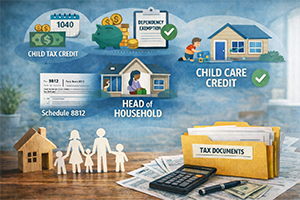
 Raising children is expensive, but the tax code provides several important benefits that can reduce the financial burden. Here is a clear, up-to-date overview of the major federal tax breaks available to families with dependent children(This article generally refers to tax years starting with tax year 2026, based on current law.)
1. Child Tax Credit (CTC)
- The Child Tax Credit is one of the most valuable tax benefits for families.
- Up to $2,200 per qualifying child
- Child must generally be under age 17 at the end of the tax year
- Income limits:
- $200,000 (single)
- $400,000 (married filing jointly)
- The credit begins to phase out above those income levels.
A portion of the credit (up to about $1,700) may be refundable, meaning you could receive money back even if you owe little or no tax.
2. Child and Dependent Care Credit
This credit helps offset the cost of childcare so parents can work or look for work.
- Covers expenses such as:
- Daycare
- After-school programs
- Summer day camps
- Expense limits:
- Up to $3,000 for one child
- Up to $6,000 for two or more children
- The percentage of expenses you can claim depends on your income. Lower-income families receive a larger percentage.
⚠️ Important: This credit is generally not refundable, meaning it reduces taxes owed but usually does not generate a refund by itself.
3. Earned Income Tax Credit (EITC)
The Earned Income Tax Credit is designed for lower- and moderate-income working families.
- The amount depends on:
- Income
- Filing status
- Number of children
- Families with multiple children can receive several thousand dollars, and in some cases over $8,000.
This credit is fully refundable, making it especially valuable.
4. Head of Household Filing Status
Many single parents qualify for Head of Household filing status, which provides:
- A higher standard deduction
- More favorable tax brackets
- To qualify, you generally must:
Pay more than half the cost of maintaining a home, and
Have a qualifying child living with you for more than half the year
This is often one of the most overlooked tax benefits.
5. Adoption Credit
Families who adopt a child may qualify for a significant tax credit.
- Up to approximately $17,000+ per child (adjusted annually)
- Covers qualified adoption expenses such as:
- Legal fees
- Court costs
- Travel
- This credit can substantially offset the cost of adoption.
6. Education-Related Benefits (Briefly)
While not limited to young children, families should also be aware of:
- American Opportunity Credit (college expenses)
- Lifetime Learning Credit
- These can become relevant as children get older.
What About the “Dependency Exemption”?
You may remember that taxpayers used to claim a separate dependency exemption for each child.
- That exemption is currently eliminated (set at $0) under federal law
- It has not been restored, although future changes are always possible
- Most of its value has effectively been replaced by the Child Tax Credit and other benefits.
Important Considerations for Divorced or Separated Parents
For parents who are divorced or separated, these tax benefits can become complicated.
In most cases:
- The parent who the child lives with more than 50% of the time is entitled to claim the child
- However, parents can agree (in a separation agreement or court order) to allocate tax benefits differently
- These decisions can have significant financial consequences, so they should be addressed carefully in any divorce agreement.
Final Thoughts
Tax benefits for families can be substantial, but the rules are detailed and sometimes confusing. Understanding what credits are available—and who is entitled to claim them—can make a meaningful difference in your finances.
If you are going through a divorce or separation, it is especially important to address these issues clearly so there are no disputes later.