
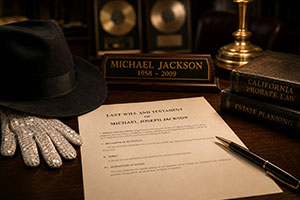
Few celebrities have left behind a larger cultural legacy than Michael Jackson. Known as the “King of Pop,” Jackson revolutionized music, dance, and entertainment. Yet when he died unexpectedly on June 25, 2009, at the age of 50, he left behind not only grieving fans but also one of the most closely watched probate proceedings in modern history.
Surprisingly, Michael Jackson’s Last Will and Testament is remarkably brief. Rather than attempting to address every possible issue within the will itself, Jackson used a sophisticated estate-planning technique that many attorneys recommend today: a pour-over will combined with a revocable living trust.
His estate demonstrates both the strengths and limitations of this approach.
A Five-Page Will
Michael Jackson signed his Last Will and Testament on July 7, 2002, approximately seven years before his death. The document contains only a handful of substantive provisions.
Among its most important features, Jackson:
-
Revoked all prior wills.
-
Declared that he was divorced from Deborah Rowe and identified his three children.
-
Left his entire probate estate to the trustee of the Michael Jackson Family Trust, rather than directly to individual beneficiaries.
-
Named attorney John Branca and music executive John McClain as co-executors. Attorney Barry Siegel was also nominated but later declined to serve.
-
Nominated his mother, Katherine Jackson, as guardian of his minor children, with singer Diana Ross designated as the alternate guardian if Katherine could not serve.
-
Specifically provided that his former wife, Deborah Rowe, would receive nothing under the will.
Although only five pages long, the will reflected careful and sophisticated estate planning.
The Trust Was the Real Estate Plan
The most important sentence in Michael Jackson’s will is the one that receives the least public attention.
Instead of distributing property directly to family members, the will transfers the entire probate estate to the Michael Jackson Family Trust, a revocable living trust that Jackson had previously established and amended.
Lawyers often refer to this type of document as a pour-over will because any assets passing through probate are “poured over” into the trust after death.
This structure offers several important advantages:
-
A single trust governs the distribution of all assets.
-
Property can continue to be professionally managed without interruption.
-
Distributions to beneficiaries can be delayed or staggered over many years.
-
Most of the detailed distribution provisions remain private because trusts generally are not filed with the probate court.
-
The trust can continue to manage assets long after the probate estate has been closed.
Why Estate Planning Attorneys Often Prefer Pour-Over Trusts
Michael Jackson’s estate also illustrates another reason many estate-planning attorneys recommend a revocable living trust.
When someone dies with only a will, the probate court notifies heirs and beneficiaries that the will has been offered for probate. The will becomes a public record, and anyone with standing has a clearly defined procedure for filing a will contest.
A pour-over trust changes that landscape.
Although the will itself is public, the trust agreement often is not. A potential challenger may not know the detailed terms of the trust or even who ultimately receives the property. That lack of information can make it more difficult to evaluate whether litigation is worthwhile or to draft a detailed complaint challenging the trust.
In addition, a revocable trust is created and administered during the settlor’s lifetime. If the trust operated for years before death, courts may view that history as evidence that the settlor accepted the trust’s terms and administration. While trusts certainly can be challenged on grounds such as lack of capacity, undue influence, fraud, or improper execution, those challenges typically require a separate civil action rather than the relatively straightforward procedures used to contest a will in probate court.
For these reasons, many estate-planning attorneys view a properly funded revocable trust as providing not only management and privacy benefits but also an additional layer of practical protection against post-death litigation.
Privacy—To a Point
Many people assume that having a trust keeps an estate completely private.
Michael Jackson’s estate demonstrates that the reality is more complicated.
Because the will had to be admitted to probate, the public learned:
-
who Jackson selected as co-executors,
-
who he nominated as guardians,
-
that his assets passed to the Michael Jackson Family Trust, and
-
the existence of the trust itself.
However, the detailed provisions of the trust—including precisely how and when beneficiaries would receive distributions—generally remained confidential.
Guardianship of His Children
One of the will’s most important provisions involved Jackson’s three minor children.
He nominated his mother, Katherine Jackson, to serve as guardian.
Recognizing that circumstances can change, he also named Diana Ross as successor guardian if Katherine could not serve.
This illustrates a valuable estate-planning lesson. Parents should almost always name both a primary and an alternate guardian. Life rarely unfolds exactly as expected.
A Fortune Buried Under Debt
When Michael Jackson died, media reports focused heavily on his financial difficulties.
At the time, he reportedly owed hundreds of millions of dollars. Nevertheless, he also owned extraordinarily valuable assets, including interests in music publishing, copyrights, trademarks, licensing rights, and other intellectual property.
What followed became one of the greatest financial turnarounds in estate history.
Under the management of the executors, the estate generated billions of dollars through music sales, licensing agreements, theatrical productions, merchandising, and other business ventures. Today, the Estate of Michael Jackson is widely regarded as one of the most successful celebrity estates ever administered.
Why Has the Estate Taken So Long?
Many people assume that probate lasts only a few months.
Michael Jackson’s estate demonstrates why complex estates often remain open for many years—or even decades.
Among the reasons for the lengthy administration have been:
-
disputes with the Internal Revenue Service over the value of estate assets,
-
management of valuable intellectual property,
-
licensing and publishing transactions,
-
ongoing litigation,
-
tax disputes, and
-
disagreements among beneficiaries and fiduciaries.
Even more than fifteen years after Jackson’s death, aspects of the estate administration continue because of ongoing tax and fiduciary issues.
Estate Planning Lessons
Michael Jackson’s will offers several practical lessons for anyone preparing an estate plan.
Keep your will simple. A short, carefully drafted will is often far more effective than a lengthy document filled with unnecessary detail.
Consider using a revocable living trust. A trust can provide continuity of management, preserve privacy regarding the disposition of assets, allow long-term management for beneficiaries, and reduce many of the practical issues that arise during probate. For individuals with significant assets, business interests, blended families, or privacy concerns, a revocable living trust can be one of the most valuable estate-planning tools available.
Choose fiduciaries carefully. Jackson selected experienced professionals—not simply family members—to administer an extraordinarily valuable and complex estate.
Name alternate guardians. Parents should always consider who would care for their children if their first choice cannot serve.
Review your estate plan periodically. Jackson’s will was executed seven years before his death. Periodic reviews help ensure that fiduciaries, guardians, and beneficiaries remain appropriate as family circumstances change.
Understand that even excellent planning cannot eliminate every dispute. Tax controversies, creditor claims, business interests, and family disagreements may continue long after a person’s death. Good estate planning can reduce these disputes, but it cannot eliminate them entirely.
Why This Will Still Matters Today
Michael Jackson’s Last Will and Testament is not famous because it contains unusual legal language. Quite the opposite.
Its significance lies in demonstrating that sophisticated estate planning often depends less on the will itself than on the planning documents working behind the scenes.
The will served primarily as a gateway to a carefully designed trust. While the administration of the estate has involved years of litigation, complex tax issues, and the management of an extraordinary entertainment empire, the estate-planning structure Jackson established in 2002 continues to govern one of the most valuable celebrity estates in history.
For lawyers, law students, and anyone interested in estate planning, Michael Jackson’s will is an excellent reminder that the most effective estate plans are often the simplest on paper.
Read the Original Documents
One goal of this series is to allow readers to examine the original legal documents that shaped history. The following records are publicly available and provide an opportunity to see how Michael Jackson’s estate plan was implemented.
Michael Jackson’s Last Will and Testament
The complete signed Last Will and Testament dated July 7, 2002, may be viewed here:
https://www.documentcloud.org/documents/19395-michael-jacksons-will/
This is a scanned copy of the will that was filed with the court.
Probate Petition
The Petition for Probate filed in the Los Angeles County Superior Court shortly after Michael Jackson’s death may be viewed here:
https://i.cdn.turner.com/cnn/2009/images/06/29/jackson.probate.pdf
This filing initiated the probate proceeding and identifies the nominated executors, heirs, and other information relevant to the administration of the estate.
Note: These documents are public court records and are provided for historical and educational purposes.