
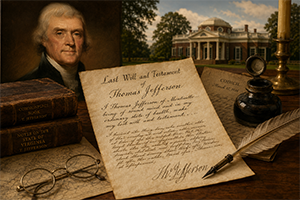
Thomas Jefferson is remembered as the principal author of the Declaration of Independence, the third President of the United States, the founder of the University of Virginia, and one of America’s greatest political philosophers.
Yet when Jefferson died on July 4, 1826—the fiftieth anniversary of the Declaration of Independence—he left behind something many people do not associate with one of America’s greatest statesmen: enormous debt.
His last will and testament provides a fascinating look at estate planning, family protection, slavery, and the limits of even the best-drafted will when an estate is insolvent.
Writing His Own Will
Jefferson personally drafted his will entirely in his own handwriting on March 16, 1826, and added a codicil the following day.
The opening is simple and familiar to lawyers today:
“I Thomas Jefferson of Monticello… being of sound mind and in my ordinary state of health, make my last will and testament…”
Although nearly two centuries old, the language reflects many of the same legal concepts found in modern wills.
Providing for His Family
Jefferson’s primary concern was providing for his surviving family.
One of his significant gifts was the Poplar Forest plantation to his grandson, Francis Eppes.
The remainder of his estate was placed into a carefully constructed trust arrangement for the benefit of his daughter, Martha Randolph, and her family. Jefferson was especially concerned because his son-in-law, Thomas Mann Randolph, was financially insolvent.
Jefferson feared that creditors could seize property intended for his daughter if it passed directly through her husband. To avoid this result, he created a trust with trustees who would hold legal title while preserving the beneficial interest for Martha and her heirs.
This portion of the will demonstrates Jefferson’s considerable legal sophistication. Long before modern asset-protection planning became common, he understood how trusts could help protect family assets from a beneficiary’s spouse and creditors.
“Pay My Debts First”
Like many wills today, Jefferson directed that his debts be paid before distributions were made to beneficiaries.
Unfortunately, his debts far exceeded what most people realized.
Jefferson had accumulated substantial obligations through years of maintaining Monticello, financing agricultural operations, guaranteeing loans for relatives, and living beyond his means. Despite his fame, he was cash-poor for much of his later life.
Because creditors had priority, much of the property that Jefferson hoped would remain in the family ultimately had to be sold.
The Tragic Reality
Jefferson carefully planned his estate.
His legal drafting was thoughtful.
His intentions were clear.
But one reality overwhelmed everything else.
A will cannot create assets that do not exist.
Jefferson’s estate owed so much money that many of his plans could not be fully carried out.
After his death:
- Much of his personal property was sold at public auction.
- Monticello itself was eventually sold by his heirs.
- The family’s financial difficulties continued for years.
- Many possessions Jefferson hoped would remain with his descendants were lost forever.
Jefferson’s estate remains one of history’s best examples that careful estate planning cannot substitute for sound financial planning.
Freedom Granted in His Will
Jefferson’s will is also historically significant because it granted freedom to several enslaved people who had served him at Monticello, including Burwell Colbert, whom Jefferson described as his “good, affectionate, and faithful servant.” He also directed that Madison and Eston Hemings be freed when they reached the age of twenty-one and requested legislative approval to facilitate their freedom under Virginia law.
Even so, the vast majority of the enslaved people at Monticello were not emancipated through his will. Because Jefferson’s estate was heavily indebted, many enslaved individuals were sold after his death to satisfy creditors. His final testament therefore reflects both limited acts of emancipation and the tragic realities of slavery and indebtedness in early nineteenth-century Virginia.
Appointment of an Executor
Jefferson named his grandson, Thomas Jefferson Randolph, as his executor, with successor executors designated if necessary.
Choosing someone he trusted to carry out his wishes was one aspect of his estate plan that worked as intended.
Unfortunately, even the most capable executor cannot overcome an insolvent estate.
The Language of the Will Reflects Its Time
Jefferson’s will illustrates how both legal drafting and property law have evolved over the past two centuries.
Metes and Bounds Descriptions
When Jefferson devised Poplar Forest to his grandson, Francis Eppes, he described the property by tracing its perimeter from one landmark to another. This method of describing land is known as a metes and bounds description.
Modern deeds in many parts of the United States still contain metes and bounds descriptions, particularly for older parcels and rural property. Modern wills, however, almost never do. Today, a will usually identifies real estate simply by its street address or by referring to “my real estate located at” a particular address because the complete legal description already appears in the recorded deed.
Jefferson likely included the detailed metes and bounds description because he wanted to identify precisely which tract of his extensive landholdings he intended to devise. Including the full legal description eliminated uncertainty over exactly what property would pass to his grandson.
A Holographic Will
Jefferson’s original will was entirely in his own handwriting and was not signed by subscribing witnesses. Instead, the will was admitted to probate under Virginia law after proof of Jefferson’s handwriting and execution.
A will that is entirely written and signed by the testator without witnesses is commonly called a holographic will.
Today, several states continue to recognize holographic wills if they satisfy statutory requirements. Massachusetts, however, generally does not. Under the Massachusetts Uniform Probate Code, a will executed in Massachusetts ordinarily must be signed by the testator and witnessed by at least two individuals. Nevertheless, Massachusetts may recognize a holographic will that was validly executed in another state or country under that jurisdiction’s law.
Jefferson’s will therefore provides an interesting example of how estate-planning formalities have evolved over time.
Lessons for Modern Estate Planning
Jefferson’s will teaches several lessons that remain relevant today.
- A Will Cannot Eliminate Debt
Creditors are generally paid before beneficiaries receive inheritances. Estate planning works best when combined with sound financial management.
- Trust Planning Can Protect Family Members
Jefferson’s trust provisions show an advanced understanding of protecting assets for future generations.
- Estate Planning Is More Than Distributing Property
Jefferson carefully considered family dynamics, creditor issues, and future management of property.
- Update Your Estate Plan
Jefferson executed both a will and a codicil shortly before his death, demonstrating the importance of reviewing estate-planning documents as circumstances change.
Read Thomas Jefferson’s Will
The complete text of Thomas Jefferson’s last will and testament is available through the Thomas Jefferson Foundation at Monticello:
Thomas Jefferson’s Last Will and Testament
https://www.monticello.org/encyclopedia/last-will-and-testament/
It is well worth reading. Beyond its historical significance, it offers remarkable insight into one of America’s greatest founders—not simply as a President, but as a father, grandfather, landowner, debtor, and man facing the end of his life.
Final Thoughts
Thomas Jefferson’s will reminds us that even brilliant lawyers, statesmen, and presidents cannot escape the basic rules of estate administration.
A carefully drafted will is an essential part of an estate plan, but it is only one piece of the puzzle. Sound financial management during life often determines whether a person’s final wishes can ultimately be carried out.
Jefferson left behind ideas that changed the world. Ironically, he could not preserve the estate he spent a lifetime building.
Why This Will Still Matters Today
At first glance, Thomas Jefferson’s will may seem like nothing more than a historical curiosity. It was written two hundred years ago by one of America’s Founding Fathers under laws that differ significantly from those in effect today.
Yet the issues Jefferson faced are remarkably familiar.
He wanted to provide for his family, protect a loved one from creditors, choose a trusted executor, distribute specific real estate, and ensure that his debts were paid. These are the same concerns that lead people to prepare wills today.
Jefferson’s estate also illustrates an important truth that every estate planning attorney eventually encounters: a well-written will cannot overcome poor financial circumstances. Creditors are generally paid before beneficiaries inherit, regardless of how carefully a will is drafted.
The document also demonstrates how estate-planning law continues to evolve. Formalities that were acceptable in Virginia in 1826—such as proving a handwritten will without subscribing witnesses—would generally not satisfy Massachusetts law today. At the same time, many of Jefferson’s planning concepts, including the use of trusts to protect family members and the careful selection of an executor, remain fundamental parts of modern estate planning.
Finally, Jefferson’s will reminds us that every will tells a story. Beyond distributing property, it reveals the values, concerns, relationships, and hopes of the person who wrote it. Reading the wills of history’s most influential people allows us to better understand not only the law, but also the lives of those who helped shape our nation.
That is what makes Thomas Jefferson’s last will and testament far more than an old legal document—it remains a valuable lesson in estate planning, financial responsibility, and human nature.