
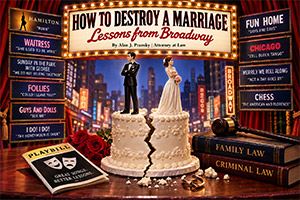
Broadway has given us some wonderful lessons about love and marriage. It has also given us a remarkably good instruction manual for destroying one.
Musicals are filled with marriages and relationships damaged by adultery, neglect, resentment, selfishness, misplaced priorities, anger, and betrayal. The characters may sing beautifully while doing it, but their mistakes are very real.
So, if you want to know how to ruin a marriage, Broadway has some suggestions.
“Burn” — Hamilton
Commit Adultery
Few things can destroy a marriage as quickly as adultery.
In Hamilton, Alexander Hamilton has an affair with Maria Reynolds and then, in an effort to protect his political reputation, publicly reveals the affair. His wife, Eliza, is humiliated not merely by the betrayal itself but by having the most private part of their marriage exposed to the world.
Adultery is more than a bad decision or a moment of weakness. It is a violation of one of the most sacred trusts of marriage. And the damage often extends far beyond the affair itself. There are lies to conceal it, excuses to justify it, and sometimes public humiliation when it becomes known.
Broadway’s lesson is simple: if you want to destroy trust in a marriage, betray it.
“She Used to Be Mine” — Waitress
Make Your Spouse Lose Herself
A destructive marriage does not always end with a dramatic betrayal. Sometimes the damage happens gradually.
Jenna looks at the person she has become and barely recognizes herself. Her marriage to Earl is controlling and abusive, and over time her confidence, independence, and sense of possibility have been worn away.
That is another way to destroy a marriage: make the other person smaller. Control the money. Dismiss dreams. Undermine confidence. Make your spouse feel that his or her needs, ambitions, and identity no longer matter.
A healthy marriage should allow both spouses to grow. A destructive one can cause a spouse to disappear.
“We Do Not Belong Together” — Sunday in the Park with George
Put Your Work Before Your Partner
George is devoted to his art. Dot loves George, but she is increasingly forced to compete with his work for his attention.
The problem is not simply that George works too much. His art consumes him. Even when Dot is physically beside him, George’s attention is often somewhere else—on the painting, on his ideas, on what he is trying to create. Dot wants more than proximity. She wants to feel that she matters to him.
Their confrontation in “We Do Not Belong Together” shows two people who care about each other but want very different things from the relationship. Dot wants George to notice her, listen to her, and make room for her in his life. George cannot—or will not—give her the kind of attention she needs because doing so would require him to take some of his attention away from his work.
That problem is hardly confined to artists. A demanding career, a business, a hobby, a cause, or even a smartphone can become the third person in a marriage. There is nothing wrong with being ambitious or passionate about your work. The danger comes when your spouse repeatedly receives whatever time, energy, and attention remain after everything else has been satisfied.
Eventually, the neglected spouse may stop asking for attention. That does not necessarily mean the problem has been solved. It may mean that the spouse has given up trying to get it.
George does not have to choose between loving Dot and loving his art. His mistake is behaving as though only one of them deserves his full attention.
You do not have to abandon your spouse to lose your spouse. Sometimes you just have to keep choosing something else.
“Could I Leave You?” — Follies
Take Your Spouse for Granted Until She Has Had Enough
By the time Phyllis sings “Could I Leave You?,” years of disappointment and resentment have fundamentally changed the way she feels about Ben. Leaving him is no longer an unthinkable threat. She tells him that, emotionally, she left the marriage long ago.
Ben has spent much of their marriage absorbed in himself. He has enjoyed professional success and the admiration that comes with it, while Phyllis has spent years playing the role of the successful man’s wife. He has been unfaithful, emotionally distant, and remarkably confident that Phyllis will continue to be there despite his behavior. He has taken both his wife and his marriage for granted.
Now Phyllis wants him to understand the consequences.
The song is deliberately cruel. She sarcastically considers whether she could possibly leave Ben and then catalogs the things about him and their marriage that she has come to despise. She attacks his vanity, his weaknesses, his behavior, and the life they have built together. This is no ordinary marital argument. It is years of accumulated resentment being delivered all at once.
Ben’s great mistake has been assuming that because Phyllis stayed yesterday, she will stay tomorrow. But remaining in a marriage is not necessarily the same thing as remaining committed to it. Resentment can accumulate quietly until affection has been replaced by contempt.
And Sondheim does not give Ben—or us—a simple answer about what Phyllis will actually do. That is part of the sting. She has made one thing clear: Ben can no longer assume that she will stay.
“Sue Me” — Guys and Dolls
Keep Making Promises You Don’t Keep
Adelaide has waited fourteen years for Nathan Detroit to marry her. Fourteen years of promises. Fourteen years of excuses. And fourteen years of Nathan putting gambling and his floating crap game ahead of the life he has promised her.
By the time Adelaide sings “Sue Me,” she has already decided that their relationship is over. This is not another warning designed to persuade Nathan to change. She has had enough.
Nathan apologizes and admits his faults, but Adelaide is no longer looking for another apology. She has heard promises before. Her anger comes from realizing that Nathan has had years to change and has repeatedly chosen not to.
That is what makes the song more than another argument between them. Nathan is pleading his case to someone who has already reached her verdict.
There is a dangerous lesson here for any long-term relationship. Do not assume that because your partner has tolerated the same behavior for years, he or she will tolerate it forever. Repeated apologies eventually lose their value when nothing changes after them.
Sometimes the final argument is not another warning.
It is the announcement that all the previous warnings have expired.
“The Honeymoon Is Over” — I Do! I Do!
Let Affection Turn Into Hostility
Honeymoons end. That does not mean the marriage has to.
But in “The Honeymoon Is Over,” the end of the honeymoon becomes a comic catalogue of just how badly a marriage can deteriorate. Romance has given way to criticism, irritation, boredom, suspicion, infidelity, and thoughts of leaving.
The humor comes from exaggeration, but the progression is recognizable. The little things that once seemed charming become annoying. Spouses stop laughing with each other and start criticizing each other. Affection is replaced by sarcasm. Attention begins wandering outside the marriage. Eventually, the question is no longer how to make the marriage happier, but whether it is worth continuing at all.
That is a very different problem from simply discovering that married life is not a permanent honeymoon. Every long marriage eventually exchanges some excitement for familiarity. Familiarity can become intimacy, comfort, and companionship. Or, if spouses allow every irritation and disappointment to accumulate, familiarity can breed contempt.
The danger is not that the honeymoon ends. The danger is allowing everything that came after it to become something neither spouse wants to live with.
“Days and Days” — Fun Home
Let Your Spouse Give Away Her Life to the Marriage
Helen Bechdel’s marriage has required years of accommodation, silence, and sacrifice while she lives with the consequences of her husband’s secrets and behavior.
There is a difference between compromise and surrender.
Every marriage requires sacrifice, but the sacrifices cannot continually flow in only one direction. If one spouse’s ambitions, problems, secrets, or desires determine the shape of the entire family, the other spouse may eventually realize that years—or decades—have disappeared.
Helen looks back at all the ordinary days she surrendered to the marriage: the routines, responsibilities, compromises, anger, and consequences of Bruce’s behavior. What makes the song so painful is the realization that a life is not usually given away all at once. It disappears one day at a time.
A marriage should involve building a life together, not one spouse consuming the other’s life.
“Cell Block Tango” — Chicago
Let Anger, Jealousy, Betrayal, and Revenge Take Over
The women of Chicago offer perhaps Broadway’s most extreme collection of relationship problems. Each has a different grievance, but together they provide a fairly comprehensive list of ways people can make their partners miserable.
Liz has simply had enough of Bernie’s irritating habit of popping his gum. She repeatedly tells him to stop. He does it again, and she shoots him. It is an absurdly disproportionate response, of course, but underneath the joke is something recognizable in long relationships: one partner repeatedly doing something that drives the other crazy despite being asked to stop.
Annie’s problem is deception. Ezekiel tells her that he is single, but she eventually discovers that he is married—and not merely to one other woman. He has six wives. Annie responds by poisoning his drink with arsenic. Her story turns dishonesty and betrayal into an excuse for revenge.
June’s husband, Wilbur, accuses her of having an affair with the milkman. According to June, he becomes so jealous that he comes at her in a rage. She is holding a knife, and somehow Wilbur manages to run into it ten times. Her wonderfully implausible explanation turns a killing into something that sounds almost like an unfortunate accident.
Velma discovers her husband, Charlie, with her sister Veronica. She describes an enormous double betrayal: both her husband and her sister have betrayed her. Velma says that she blacks out and cannot remember what happens next. Her next memory is of washing blood from her hands.
Mona has been remarkably tolerant of Alvin Lipschitz while he supposedly tries to “find himself.” Unfortunately, he keeps finding other people instead. His repeated affairs finally become too much for her. Mona’s explanation turns repeated infidelity into the provocation for what she does.
Then there is Hunyak.
From a lawyer’s perspective, this is where “Cell Block Tango” becomes particularly interesting.
The other five women essentially admit what they did, but each immediately supplies an explanation designed to excuse or minimize it. Liz characterizes the shots she fired as warnings. Annie was deceived by a man with six wives. June’s husband somehow ran into her knife ten times. Velma cannot remember what happened after discovering her husband with her sister. Mona finally endured one affair too many.
It almost sounds as though they have all received the same excellent legal advice: if you are going to admit the killing, give the jury a reason not to convict you.
Their stories are not simply confessions. They are defenses. Each woman gives the listener a reason to sympathize with her, excuse her conduct, question her intent, or at least understand how she reached the point where the killing occurred. Whether any of these explanations would actually constitute a legal defense is another matter, but they certainly give a defense lawyer something to work with.
Hunyak apparently missed the legal-strategy meeting.
She does not claim provocation, accident, betrayal, jealousy, or loss of control. She does not admit the killing and then explain why it should be excused. She insists that she did not do it. Speaking almost entirely in Hungarian, she maintains her innocence. When she is asked directly whether she committed the crime, her defense could hardly be simpler: “Not guilty.”
Ironically, Hunyak’s insistence on innocence seems to contradict the excellent legal advice everyone else appears to have received. The others admit what happened but give the listener a story that might produce sympathy and, ultimately, an acquittal. Hunyak simply denies the accusation.
And in the strange legal universe of Chicago, where telling the right story can matter more than telling the truth, Hunyak may be the only woman telling the truth—and apparently the only one who did not get the memo about how to sell her story.
Of course, none of this is good relationship advice. Cheating, lying, betrayal, jealousy, disrespect, and repeatedly ignoring a partner’s feelings can destroy a relationship. Murder is not an acceptable response to any of them.
So don’t take marital advice from “Cell Block Tango.” If you decide to end your marriage, hire a lawyer. Don’t hire a hit man.
“Not a Day Goes By” — Merrily We Roll Along
Betray Someone Who Still Loves You
One of the cruelest forms of betrayal occurs when the person being hurt still loves the person doing the hurting.
Beth’s pain is powerful precisely because love has not disappeared. Her marriage to Frank is ending after his infidelity, but her feelings for him have not conveniently disappeared with it.
That is why betrayal can be so devastating. Divorce lawyers regularly see people who are simultaneously furious with their spouses and still deeply attached to them. Those emotions are not contradictory.
A marriage may legally end long before the emotional relationship does. Someone can know that the marriage must end and still miss the person who caused the pain. Anger and love can exist at the same time.
Love does not necessarily disappear when trust is broken. Sometimes it remains—and makes the betrayal hurt even more.
“The American and Florence” — Chess
Use Your Partner’s Weaknesses Against Them
Every long-term relationship creates vulnerability. Partners learn each other’s insecurities, fears, failures, family histories, and sensitive spots.
That knowledge can create intimacy—or provide ammunition.
In Chess, Florence confronts Freddie about his behavior. Instead of simply addressing what she is saying, Freddie turns the argument toward one of the most painful subjects in Florence’s life: Hungary and the loss of her father.
He knows where the wound is, and he presses on it.
That is an extraordinarily effective way to destroy a relationship.
When couples argue, they often know exactly which words will cause the most pain. The temptation is to use them. An insecurity revealed privately, a painful childhood experience, a family tragedy, an old failure, or a fear shared in confidence can suddenly become a weapon because one partner wants to win an argument.
But there is a price for winning that way.
Your partner trusted you with information that the rest of the world may never know. Using that knowledge against the person teaches a dangerous lesson: being vulnerable with you is unsafe.
You may win the argument.
You may also make sure your partner never trusts you with that vulnerability again.
Broadway’s Guide to Marital Destruction
Broadway makes destroying a relationship look wonderfully dramatic. There are soaring melodies, clever lyrics, beautiful costumes, and usually an orchestra available at exactly the right moment.
Real marriages generally fall apart more quietly.
Commit adultery. Put work ahead of your spouse. Take your spouse for granted. Make promises you never keep. Let affection turn into hostility. Allow one spouse to sacrifice years of his or her life for the other. Turn arguments into opportunities to wound each other. Betray someone who still loves you. Learn your partner’s vulnerabilities and then use them as weapons.
Do enough of those things and you probably will not need a Broadway orchestra.
You may need a divorce lawyer.
So enjoy watching Broadway explain how to destroy relationships. Then go home and do the opposite.