
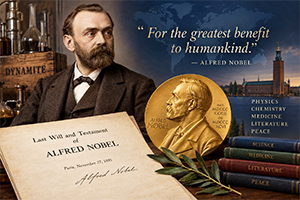
Most wills distribute property.
Alfred Nobel’s will created something much larger.
When Nobel died in 1896, the Swedish inventor and industrialist left most of his enormous fortune not to his family, but to a fund that would reward people whose work provided the greatest benefit to humanity.
The result was the Nobel Prize.
Today, Nobel’s name is probably better known because of his will than because of the inventions that made him wealthy in the first place.
Who Was Alfred Nobel?
Alfred Nobel was born in Stockholm in 1833. He became a chemist, engineer, inventor and businessman and ultimately held 355 patents. His best-known invention was dynamite.
His business interests became international, and by the end of his life Nobel had accumulated an extraordinary fortune.
But Nobel was interested in considerably more than explosives. He also had strong interests in science, medicine, literature and questions of war and peace—the subjects that would eventually appear in his will.
The Will
On November 27, 1895, Nobel signed his last will and testament in Paris.
The document begins conventionally enough.
Nobel made specific gifts to nephews, nieces, friends, employees and others. Among them were substantial bequests to members of the Nobel family, pensions for servants, and gifts to people in several different countries.
Then came the provision that changed his legacy.
Nobel directed that his remaining assets be converted into safe securities and placed in a fund. The income was to be distributed each year as prizes to people who had provided the greatest benefit to humankind.
He divided the awards into five categories:
- Physics
- Chemistry
- Physiology or Medicine
- Literature
- Peace
Nobel even identified the institutions that would select the winners. The Royal Swedish Academy of Sciences would award the physics and chemistry prizes; the Karolinska Institute would award the medicine prize; the Swedish Academy would select the literature recipient; and a five-person committee selected by the Norwegian Parliament would award the peace prize.
Nobel also included an unusually international instruction. Nationality was not supposed to matter. The award was to go to the person considered most worthy, whether Scandinavian or not.
For a wealthy nineteenth-century industrialist, this was an extraordinarily ambitious estate plan.
How Much Money Did Nobel Leave?
A great deal.
Approximately 31 million Swedish kronor from Nobel’s estate ultimately funded the prizes. The Nobel Foundation estimates that his original fortune would be worth approximately 2 billion Swedish kronor in today’s money.
Rather than simply distributing that fortune, Nobel created an endowment.
The capital would remain invested. Its earnings would finance awards year after year.
That distinction is important. Nobel did not simply make five enormous charitable gifts. He designed a mechanism intended to continue carrying out his wishes after everyone who knew him was dead.
And it worked.
The first Nobel Prizes were awarded in 1901.
There Was One Problem: Nobel’s Will Was Not Easy to Carry Out
Nobel had a grand idea.
He did not, however, leave behind a fully developed organizational structure for implementing it.
There was no Nobel Foundation when he signed the will. The institutions Nobel named had not necessarily agreed in advance to assume the responsibilities he assigned them. His property was scattered internationally. His relatives had interests of their own. And authorities in several countries had questions about the estate.
Some members of Nobel’s family challenged the plan, arguing among other things that its terms were too vague to implement.
It took approximately four years of legal work, negotiations and conflict before the plan could be put on a secure institutional footing. The Nobel Foundation was established in 1900.
The Nobel Prize therefore provides an important estate-planning lesson:
Having a great idea for your estate is not the same thing as creating a great estate plan.
Someone still has to make the idea work.
The Executors Who Made Nobel’s Plan Possible
Nobel appointed two engineers, Ragnar Sohlman and Rudolf Lilljequist, as executors.
They inherited an extraordinary assignment.
Nobel’s assets were scattered among banks, investments, real estate and business interests in several countries. His will itself identifies property and financial accounts in places including France, Scotland, Germany, Russia, Sweden and Italy.
Sohlman and Lilljequist had to bring those assets together and turn Nobel’s relatively brief testamentary instructions into a functioning international prize system.
One episode sounds more like something from a movie than the administration of an estate.
Concerned that French authorities might prevent Nobel’s securities from leaving France, the executors traveled among Paris banks by horse and carriage collecting Nobel’s stocks, bonds and other financial documents. They packed the documents into crates and sent them to Sweden from the Gare du Nord as registered luggage.
Imagine being the executor responsible for an enormous international estate and having a substantial part of it sitting in crates on a train.
Yet the executors succeeded.
Sohlman became instrumental in establishing the Nobel Foundation and arranging its relationship with the organizations responsible for selecting Nobel laureates.
Nobel’s Will Was Surprisingly Short on Details
One of the most interesting things about Nobel’s will is how much it accomplished with relatively little detail.
The critical provision tells the executors to convert the remaining property into safe securities, create a fund and distribute the investment income through the five prizes.
But Nobel did not write hundreds of pages of rules governing the prizes.
Many questions therefore had to be answered after his death.
What exactly qualified as a contribution to physics or medicine? How should the prize-awarding institutions operate? How should the money be managed? What administrative organization would oversee the fortune?
Those details ultimately had to be developed through the Nobel Foundation and its statutes.
Nobel provided the vision.
Other people had to build the machinery.
What Nobel’s Executors Did Right—and What a Modern Estate Plan Might Do Differently
Perhaps the most remarkable part of the story is that Nobel’s plan succeeded despite the weaknesses in the document itself.
Nobel apparently drafted the will without the assistance of a lawyer. One significant problem was that although he directed that his fortune be used to create a fund, he did not clearly identify a legal entity that would own and administer that fund. The Nobel Foundation did not yet exist. His executors therefore had to negotiate with Nobel’s heirs, governments and the institutions he had selected to award the prizes before his intentions could actually be carried out.
Nobel was extraordinarily fortunate in his choice of executors. Sohlman and Lilljequist did not simply collect assets, pay bills and distribute an estate. They spent years turning Nobel’s idea into a functioning institution.
A modern estate plan attempting something similar would ordinarily try to resolve many of those questions before the person creating the plan died. The charitable organization or trust could be created or clearly identified, trustees could be given detailed powers, investment and distribution standards could be established, successor trustees could be provided for, and procedures could be included for circumstances the person creating the plan could not anticipate.
In other words, Nobel’s will teaches two different lessons.
First, choose your fiduciaries carefully. The best drafting in the world still depends upon people capable of carrying out the plan.
Second, do not make your fiduciaries solve problems after your death that you could have solved while you were alive.
Nobel’s executors performed remarkably well.
A good estate plan should try to make their job considerably easier.
A Will Can Control Wealth Long After Death
Nobel’s will is a dramatic example of one of the fundamental powers of estate planning.
A person cannot live forever.
But properly structured property can continue carrying out that person’s purposes for generations.
Nobel died on December 10, 1896, in San Remo, Italy.
More than a century later, money derived from the fortune he accumulated continues to support prizes bearing his name.
His executors and the Nobel Foundation transformed his fortune into an institution capable of surviving economic crises, wars, inflation and enormous changes in science and society.
That is an extraordinary testamentary legacy.
One Last Unusual Provision
Nobel’s will contains another provision that would probably surprise most people who know him only from the prizes.
He gave explicit instructions concerning his body.
Nobel directed that after his death his arteries should be severed. Only after doctors confirmed unmistakable signs of death were his remains to be cremated.
Even the man who trusted future generations to select the world’s greatest scientific achievements apparently wanted to make absolutely certain that he was dead before they cremated him.
Read Alfred Nobel’s Will
The Nobel Prize organization has published the complete English translation of Alfred Nobel’s November 27, 1895 will. It can be read here:
https://www.nobelprize.org/alfred_nobel/will/will-full.html
The will is worth reading. It is surprisingly short considering that its instructions ultimately created one of the best-known international institutions in the world.
The Estate-Planning Lesson
Alfred Nobel’s will demonstrates that estate planning is not merely about deciding who gets your property.
It can also be about deciding what you want your property to accomplish.
Nobel could have divided his fortune among relatives and friends. Instead, after making specific gifts to people he cared about, he devoted most of his wealth to an idea.
The execution of that idea was difficult. His will was challenged. His assets were spread across several countries. His executors faced years of legal and administrative problems. And much of the organizational structure necessary to accomplish Nobel’s wishes had to be created after his death.
Yet the essential testamentary direction survived.
More than a century later, scientists, physicians, writers and advocates for peace still gather each year to receive prizes funded because an inventor sat down in Paris in 1895 and decided what he wanted his fortune to do after he was gone.
Most wills distribute a person’s estate. Alfred Nobel’s will created his legacy.
The direct address above is the Nobel Prize organization’s official English translation of the will. Read Alfred Nobel’s full will