
Most people expect that a divorce will involve dividing the family home, retirement accounts, vehicles, and personal belongings. Few people think about cemetery burial plots.
Yet burial plots can become a surprisingly emotional issue during a Massachusetts divorce. They are often purchased years before a marriage breaks down and may represent family traditions, religious beliefs, or plans that the spouses made together.
So what happens to them?
The answer depends upon several factors, including who owns the burial rights, when they were acquired, the rules of the cemetery, and what the parties are able to negotiate during the divorce.
Burial Plots Are Considered Property
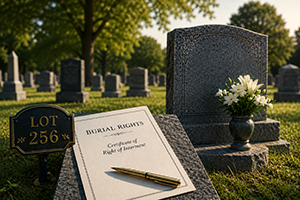
In Massachusetts, a cemetery plot is generally not ownership of the land itself. Instead, the purchaser typically acquires a contractual right of burial (sometimes called a right of interment) that is governed by the cemetery’s deed, bylaws, rules, and regulations.
Although this legal interest differs from ownership of ordinary real estate, burial rights are nevertheless considered property that may have some value. As a result, they may become part of the marital estate that is subject to division by the Probate and Family Court.
Unlike a house or bank account, however, burial rights are unique. Their true value is often measured less in dollars than in their personal, family, and religious significance.
Was the Burial Plot Purchased Before or During the Marriage?
One of the first questions is when the burial plot was acquired.
If one spouse purchased a burial plot before the marriage, that fact may weigh in favor of that spouse retaining it. However, Massachusetts follows an equitable distribution system under G.L. c. 208, § 34. Unlike many states, virtually all property owned by either spouse—whether acquired before or during the marriage—may be considered by the court when fashioning a fair division of marital assets.
Likewise, burial plots purchased during the marriage with marital funds will generally be treated as marital property, although the ultimate disposition depends upon what the judge determines is equitable after considering all of the statutory factors.
Determining the Value of a Burial Plot
One practical issue that occasionally arises is determining the value of burial rights.
Unlike publicly traded investments or real estate, cemetery plots often have no readily ascertainable market value. Some cemeteries prohibit resale altogether, while others permit transfers only under limited circumstances or reserve the right to repurchase unused plots at a predetermined price.
As a result, the value assigned to burial rights during a divorce may depend upon the cemetery’s policies, the original purchase price, the availability of comparable plots, and whether the rights can legally be transferred.
In many cases, the parties simply agree upon a reasonable value as part of their overall property settlement.
Sentimental Value Often Exceeds Financial Value
Unlike most assets, burial plots frequently have very little resale value compared to their emotional significance.
A family plot may contain generations of relatives or may have been purchased with the expectation that the spouses would eventually be buried together. Following a divorce, one or both spouses may understandably wish to change those plans.
Because of the intensely personal nature of burial rights, many couples prefer to negotiate a settlement rather than ask a judge to decide the issue.
Can the Burial Plot Be Sold?
Sometimes.
Whether burial rights may be sold or transferred depends largely upon the cemetery’s governing documents and applicable Massachusetts law.
Many cemeteries impose restrictions on transfers, require approval before any assignment, or reserve a right to repurchase unused burial rights. Others prohibit private sales altogether or limit transfers to family members.
Before assuming that a burial plot can simply be sold and the proceeds divided, it is important to review the cemetery’s deed, bylaws, and regulations.
What If One Spouse Wants to Keep the Plot?
In many cases, the simplest solution is for one spouse to retain the burial rights while the other spouse receives other marital property of comparable value.
For example, if a couple owns adjacent burial plots and one spouse has deep family ties to that cemetery, the parties may agree that spouse should retain both plots while the other spouse receives an offset elsewhere in the division of assets.
This approach often avoids future disputes and allows each party to make independent end-of-life plans following the divorce.
Religious and Family Considerations
Burial decisions frequently involve deeply held religious beliefs and longstanding family traditions.
Some individuals wish to remain in a family cemetery where parents, grandparents, or children are already buried. Others belong to religious communities that encourage burial in a particular cemetery.
Although Massachusetts property law governs the legal ownership of burial rights, these personal considerations frequently become important factors during settlement negotiations.
Existing Burials Change the Situation
If a plot already contains the remains of a deceased family member, additional legal and practical considerations arise.
The existence of prior interments may significantly limit the ability to transfer or divide burial rights. Cemetery rules, contractual restrictions, and public policy favoring the dignity and permanence of existing graves all may affect the available options.
Similarly, family mausoleums, cremation niches, and companion plots may present additional issues that require careful review.
Every Situation Is Different
Because burial rights are governed by a combination of Massachusetts law, cemetery contracts, and individual circumstances, there is no one-size-fits-all answer.
In many divorces, burial plots receive little attention until late in the case, when emotions surrounding the issue become apparent. Raising the issue early allows the parties and their attorneys to explore practical solutions before positions become entrenched.
Although burial plots are rarely among the most valuable assets in a divorce, they are often among the most personal. Taking the time to address them thoughtfully can avoid unnecessary conflict and provide peace of mind for years to come.
If you are going through a Massachusetts divorce and own cemetery burial plots, discuss them with your attorney as part of the overall property division. Careful planning today can help avoid uncertainty—and future litigation—tomorrow.