
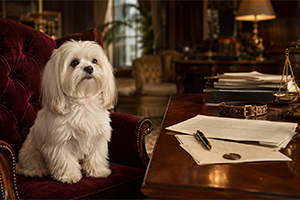
 When billionaire hotel owner Leona Helmsley died in 2007, one provision in her will attracted more attention than anything else: she directed that $12 million be placed in trust for the care of her dog, Trouble.
The bequest became one of the most famous examples of an estate plan involving a beloved pet. It also provides useful lessons about pet trusts, disinheriting relatives, no-contest clauses, judicial oversight, and careful estate planning.
Who Was Leona Helmsley?
Leona Helmsley was a wealthy New York real estate and hotel executive who became known as the “Queen of Mean.” Together with her husband, Harry Helmsley, she controlled a vast real estate and hotel empire.
She was also a controversial public figure. In 1989, she was convicted of federal tax offenses and later served time in prison.
At the time of her death, Helmsley’s estate was reportedly worth several billion dollars.
Read Leona Helmsley’s Will
Unlike the wills of many famous people from the past, Leona Helmsley’s will is readily available to the public. Reading the document itself is particularly interesting because it allows us to see exactly how she structured her estate plan rather than relying on newspaper accounts of what she supposedly did.
You can read a transcription of Leona M. Helmsley’s Last Will and Testament, dated July 15, 2005, here: https://uniset.ca/misc/helmsley_will.html?utm_source=chatgpt.com
The will is worth reading. Among other things, it contains her burial instructions, provisions for the maintenance of family mausoleums and burial plots, gifts to family members and employees, the $12 million transfer to the Leona Helmsley July 2005 Trust, and her explicit decision to make no provision for two of her grandchildren.
One important distinction is easy to miss in popular accounts of the case: the will itself does not simply say that Trouble “inherits $12 million.” Instead, Helmsley left $12 million to the trustees of Leona Helmsley July 2005 Trustand separately provided for Trouble. The terms governing the use of that trust for Trouble were part of the larger estate plan. That distinction is a useful reminder that a will may be only one part of an estate plan and cannot always be fully understood without considering the trusts and other documents to which it refers.
Trouble’s $12 Million Trust
Trouble was Helmsley’s white Maltese. In her will, Helmsley directed that $12 million be placed in trust for the dog’s care.
The trust was intended to pay for Trouble’s food, grooming, veterinary treatment, security, and other expenses. Helmsley also expressed detailed wishes concerning Trouble’s care and directed that the dog be buried beside her in the family mausoleum when Trouble died.
Although newspapers commonly reported that Trouble “inherited” $12 million, the dog did not legally own the money. An animal cannot ordinarily receive and manage property in the same manner as a person. Instead, the money was held in trust and administered for Trouble’s benefit.
The Court Reduced the Trust
The amount Helmsley provided for Trouble became part of the litigation surrounding her estate.
In 2008, a New York court approved an agreement that reduced Trouble’s trust from $12 million to $2 million. Of the $10 million removed from the trust, $4 million went to the Helmsley charitable trust and a combined $6 million went to two grandchildren whom Helmsley had excluded from her will.
Trouble’s caretaker represented that $2 million would be sufficient to provide for the dog during the remainder of her life.
The case illustrates an important limitation of pet trusts. Even when a person has the right to provide generously for an animal, an excessive trust may attract challenges and judicial scrutiny. A well-designed pet trust should provide enough for the animal’s expected needs without setting aside an amount so disproportionate that it invites litigation.
Trouble Needed Security
Trouble’s inheritance made the dog internationally famous, but that fame created problems. The dog reportedly received kidnapping and death threats and required full-time security.
After Helmsley’s death, Trouble lived with Carl Lekic, the general manager of the Helmsley Sandcastle Hotel in Sarasota, Florida. Lekic cared for Trouble until the dog died in 2010.
Trouble’s annual expenses reportedly included substantial amounts for security, veterinary care, grooming, food, and the caretaker’s services. Money remaining in the trust after Trouble’s death was distributed according to the governing documents.
Helmsley’s Grandchildren
Helmsley had four grandchildren. She left substantial inheritances to two of them but excluded the other two, Craig and Meegan Panzirer.
Her will stated that the two grandchildren were excluded “for reasons which are known to them.” Because they received nothing under the will, they had no inheritance to protect and no financial reason to refrain from challenging the estate plan.
Craig and Meegan were the children of Helmsley’s only son, Jay Panzirer, who had predeceased her. If Helmsley’s will were set aside and her property passed by intestacy, her grandchildren stood to inherit as her descendants. The two excluded grandchildren therefore had both standing and a powerful financial incentive to challenge the will.
They asserted claims against the estate and ultimately received a combined settlement of $6 million.
A person generally has considerable freedom to decide who will inherit property. Nevertheless, completely disinheriting a close relative—especially one who would inherit if the will were invalidated—may invite a will contest. Provocative language such as “for reasons which are known to them” may further inflame the dispute without strengthening the estate plan.
An estate plan should accomplish the client’s wishes without unnecessarily encouraging litigation. In Helmsley’s case, excluding two grandchildren entirely gave them every reason to contest the will and nothing to lose by doing so.
Could Helmsley Have Discouraged the Will Contest?
Helmsley might have reduced the likelihood of a contest by leaving Craig and Meegan something under the will rather than disinheriting them completely.
For example, she could have left each grandchild $1 million and included an in terrorem, or no-contest, clause. Such a clause generally provides that a beneficiary who contests the will forfeits the inheritance the will otherwise gives that person.
The strategy would have presented each grandchild with a choice: accept the $1 million inheritance or challenge the will and risk losing it.
From Helmsley’s perspective, two $1 million bequests would have represented only a tiny portion of a multibillion-dollar estate. From the grandchildren’s perspective, however, $1 million would have been a substantial and certain benefit.
This approach would have been more effective than leaving each grandchild a merely nominal amount, such as one dollar. A person who stands to lose only one dollar has no practical financial reason to refrain from filing a will contest. For a no-contest clause to discourage litigation, the inheritance at risk must be large enough to matter to the potential contestant.
Even a $1 million gift, however, might not have prevented litigation in Helmsley’s case. If the grandchildren succeeded in invalidating the will and the estate passed under an earlier will or by intestacy, they might have received vastly more. The possibility of obtaining a share of a multibillion-dollar estate could have made the challenge worth the risk.
To create a stronger deterrent, Helmsley might have needed to leave the grandchildren an even larger amount—one large enough to make surrendering a guaranteed inheritance a serious gamble.
New York law generally recognizes no-contest provisions, subject to statutory exceptions. A properly drafted clause therefore could have strengthened the deterrent, although it could not have made litigation impossible.
The Helmsley estate illustrates a practical limitation of an in terrorem clause: it cannot deter a completely disinherited heir because that person has nothing to forfeit. Sometimes leaving a dissatisfied heir a relatively small—but personally significant—share of the estate may be more effective than leaving the heir nothing at all.
Helmsley’s Other Unusual Conditions
Helmsley’s estate plan contained other unusual provisions.
Two grandchildren who received substantial inheritances were required to visit their father’s grave at least once each calendar year. They were expected to sign a registration book at the mausoleum to prove that they had complied with the condition.
Conditions attached to an inheritance can sometimes be enforced, but they must be clearly written and must not violate public policy. They can also create administrative problems and generate disputes over whether the beneficiary complied.
Before imposing such a condition, a testator should consider who will monitor compliance, what evidence will be required, and what will happen if compliance becomes impossible.
Helmsley’s Plans for Her Burial
Helmsley directed that she be buried in the Helmsley family mausoleum at Sleepy Hollow Cemetery in New York. She also wanted Trouble’s remains placed there after the dog’s death.
That part of her plan could not be carried out because the cemetery did not permit animal remains to be buried there.
This demonstrates another estate-planning lesson: unusual burial instructions should be discussed with the cemetery or funeral provider in advance. A direction in a will cannot override cemetery regulations or applicable law.
The Charitable Trust Controversy
Helmsley left most of her vast fortune to the Leona M. and Harry B. Helmsley Charitable Trust. A separate mission statement indicated that the trustees should use the trust primarily for the care and welfare of dogs while also permitting charitable purposes benefiting people.
After her death, a court ruled that the trustees were not legally required to devote the entire charitable fortune to dogs. The trustees therefore retained discretion to make grants for healthcare and other charitable purposes.
The controversy shows why charitable intentions should be expressed in clear and legally enforceable language. A separate statement of wishes may not have the same legal effect as a mandatory provision in the governing trust document.
Estate-Planning Lessons from Trouble
The story of Trouble is entertaining, but it also illustrates several serious estate-planning principles.
First, pets cannot simply be treated like human beneficiaries. A trust or another legally recognized arrangement is usually needed.
Second, the amount placed in a pet trust should bear a reasonable relationship to the animal’s anticipated needs. An excessive amount may invite a court challenge or reduction.
Third, a pet owner should select both a reliable caretaker and a responsible trustee. Leaving money without identifying a willing caretaker may not protect the animal.
Fourth, the estate plan should specify who will receive any money remaining after the pet dies.
Fifth, completely disinheriting an heir may encourage rather than prevent litigation. A meaningful gift combined with a carefully drafted no-contest clause may sometimes provide a stronger deterrent.
Finally, unusual instructions—particularly burial directions and conditions imposed on beneficiaries—should be investigated in advance to determine whether they can legally and practically be carried out.
Conclusion
Leona Helmsley’s decision to provide $12 million for Trouble made headlines around the world. Although the trust was reduced, Trouble remained well cared for throughout the rest of her life.
The estate also became involved in disputes concerning Helmsley’s grandchildren, her charitable intentions, and her unusual burial directions. Some of those disputes might have been reduced through more carefully structured provisions.
The case demonstrates that a pet trust can provide meaningful protection for an animal after its owner’s death. It also shows that an estate plan must consider not only who should receive property, but also how disappointed heirs may respond.
A well-drafted estate plan anticipates those problems. It identifies who will provide care, explains how money will be managed, creates appropriate incentives for beneficiaries, and establishes a practical plan that can be followed after the owner is gone.