
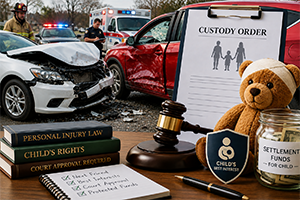
If you are divorced and your child is injured at the pool, on a playground, or in a car accident, you may wonder who handles the child’s injury claim. There are two common assumptions when an accident occurs: either the parent with primary custody handles it, or the parent who was at the scene handles it. However, as a personal injury lawyer can explain, your child’s injury case is handled by a different court and under different rules than the custody order.
A Child Cannot Bring A Claim On Their Own
Anyone under the age of 18 lacks the legal capacity to file a lawsuit or even to sign a settlement. If something like a car accident occurs and that young person has a claim, an adult has to stand in for them as “next friend.” This is for the injury lawsuit only, and it ends when that case ends. It is not custody or guardianship, and it does not affect the parenting arrangement. Now the question comes to: who gets to be the “next friend?” How is that determined?
Only One Parent Can Run The Case
Either parent can be the “next friend.” Joint legal custody does not mean both parents get to fulfill or even share this role. If both parents petition to take over this role, the judge will decide who gets it based on the child’s best interests. It is important to note that if either parent has a conflict of interest, they cannot serve as the “next friend.” For example, if a parent was driving while the child was hurt, they cannot fulfill this role. This is because the parent is a potential defendant; suing yourself on your child’s behalf does not make sense. In a case like this, the other parent or a neutral third party will step in to take over.
The Judge Reviews The Settlement
When a minor is involved, a settlement above a certain amount is not binding until a judge approves it, even if all parties agree. The court holds a hearing to review whether the amount is reasonable given the circumstances. The judge considers the child’s medical costs, the expense of ongoing care such as physical therapy, the attorney’s fees, and how the money will be held. The judge may reject a settlement that the “next friend” already agreed to if they feel it is not in the child’s best interests.
The Money Does Not Go To Either Household
As our friends at Cohen & Cohen can share, settlement money for a child is held in a way that keeps it out of both households. For larger amounts, the court may require a conservator to be appointed to manage the funds. The money may instead be placed in a structured annuity that pays out over time, or in a trust if the child has ongoing needs. The child can access this when they turn 18 or on the schedule the court sets. If it is a larger amount, neither parent can spend it on rent, groceries, or even the child’s day-to-day expenses. It is important to note that a parent who paid their child’s medical bills out of pocket may have their own claim to have those costs covered, but that claim belongs to the parent, not the child, and is handled separately.
There are many nuances to a minor’s injury case, so if your child has recently been injured due to the negligence of another party, contact an attorney near you for help immediately.