
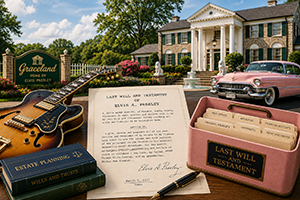
When Elvis Presley died at Graceland on August 16, 1977, at only 42 years old, he left behind far more than a famous mansion.
He left music royalties, contracts, personal property, real estate and one of the most valuable names in entertainment history.
He also left a will.
Unlike some celebrities who die without an estate plan, Elvis had signed his Last Will and Testament only a little more than five months before his death. Although the will is relatively short, it created a structure for managing an estate that would continue to generate income and attract public attention for decades.
You Can Read Elvis Presley’s Actual Will Online
One of the purposes of this series about historic and famous wills is to allow readers to see the actual documents whenever they are available.
The full text of Elvis Presley’s Last Will and Testament is reproduced by the OpenLab at New York City College of Technology, part of the City University of New York (CUNY).
Read Elvis Presley’s Last Will and Testament:
The document contains 15 separate sections dealing with such subjects as Elvis’s real estate, personal property, family trust, royalties, spendthrift protection and the powers of his executor and trustee.
Elvis Signed His Will Five Months Before His Death
Elvis signed his Last Will and Testament on March 3, 1977.
He died on August 16, 1977.
The will was admitted to probate and ordered recorded in Shelby County, Tennessee, on August 22, 1977.
Elvis appointed his father, Vernon E. Presley, as both executor of his estate and trustee of the trusts created by the will.
Perhaps most importantly, Elvis did not simply leave everything outright to his nine-year-old daughter, Lisa Marie.
Instead, most of his estate went into a trust.
Who Were the Beneficiaries of Elvis Presley’s Will?
Under Item IV of the will, Elvis placed the residue of his estate into a trust.
The trustee was authorized to use trust income and principal for the health, education, support, maintenance and welfare of:
-
Elvis’s daughter, Lisa Marie Presley, and any other children Elvis might have;
-
his grandmother, Minnie Mae Presley;
-
his father, Vernon E. Presley; and
-
certain other relatives who needed emergency assistance.
Elvis’s daughter, Lisa Marie Presley, and any other children Elvis might have;
There was an important limitation on that last category.
Assistance to other relatives could be provided only if it would not interfere with the trust’s ability to provide for Lisa Marie, Vernon and Minnie Mae. Upon Vernon’s death, those other relatives ceased to have an interest in the trust.
The provision combined two goals. Elvis wanted to provide for his immediate family while also giving his trustee some flexibility to help other relatives who genuinely needed assistance.
What Did Lisa Marie Presley Inherit?
Lisa Marie Presley was Elvis’s only child and was just nine years old when her father died.
Elvis’s will did not give his fortune directly to her.
Instead, the will created a sequence for determining who would ultimately receive the remaining trust property.
During the initial trust period, the principal beneficiaries were Lisa Marie, Vernon and Minnie Mae. Vernon died in 1979. Minnie Mae died in 1980. Lisa Marie therefore became the surviving member of that group of principal beneficiaries.
The will then provided for the property to remain in trust for Elvis’s children until the applicable child reached age 25. Because Lisa Marie was Elvis’s only child, she ultimately became entitled to the remaining trust property when she reached that age.
In other words, Lisa Marie’s eventual ownership was not the result of a simple gift saying, “I leave everything to Lisa Marie.” It resulted from the distribution formula Elvis established in his will and the family circumstances that actually occurred after his death.
Lisa Marie turned 25 on February 1, 1993.
This illustrates an estate-planning decision that parents still face today.
Reaching age 18 may make a child a legal adult, but that does not necessarily mean a parent wants the child to receive a substantial inheritance immediately. A trust can permit money to be used for a child’s education, support and other needs while postponing the child’s unrestricted control over the inheritance.
Elvis chose 25.
Other parents might choose 25, 30, 35 or provide for distributions in stages.
Did Elvis Leave Graceland to Lisa Marie?
Not directly.
It is commonly said that Lisa Marie “inherited Graceland from Elvis.” That is true as a description of the eventual result, but it oversimplifies what Elvis’s will actually did.
There is no provision in the will stating, “I leave Graceland to my daughter, Lisa Marie.”
Instead, Item III placed Elvis’s real estate within the broader estate plan and authorized his executor and trustee to hold real estate as an investment or sell it if doing so was considered to be in the best interests of the estate and its beneficiaries.
Graceland therefore became part of the property governed by the trust provisions of Elvis’s will.
The will established a formula rather than making a specific gift of Graceland. It identified a group of beneficiaries, provided for their support from the trust, established what would happen as members of that group died, and ultimately directed distribution of the remaining property to Elvis’s children or their descendants under the circumstances specified in the will.
What happened after Elvis’s death determined how that formula operated.
Vernon died. Minnie Mae died. Elvis had no additional children. Lisa Marie survived and eventually reached age 25.
The result was that Lisa Marie ultimately became entitled to the remaining trust property, which included Graceland.
This distinction matters.
A will can determine the eventual owner of property without naming that person as the direct recipient of the particular asset. Estate plans frequently use trusts, survivorship provisions, contingent beneficiaries and distribution formulas precisely because the person making the will cannot know who will survive whom or what the family’s circumstances will be years later.
What Happened When Elvis’s Father Died?
Vernon Presley died in 1979, less than two years after Elvis.
Fortunately, Elvis’s will anticipated the possibility that his father might be unable to continue serving.
Item XI authorized Vernon, through his own will, to appoint a successor executor and successor trustee. Elvis’s will also named the National Bank of Commerce in Memphis as a fallback successor if necessary.
Under Vernon’s will, successor co-executors and co-trustees included the National Bank of Commerce, accountant Joseph Hanks and Priscilla Presley.
That last name deserves attention.
Priscilla Wasn’t a Beneficiary — But She Still Became a Trustee
Elvis and Priscilla Presley divorced in 1973, approximately four years before Elvis died.
Priscilla was not a beneficiary under Elvis’s will.
Yet after Vernon died, Priscilla became one of the people responsible for administering the trust that held property ultimately intended for Lisa Marie.
There is nothing inherently improper about that arrangement. Priscilla was Lisa Marie’s mother, and her later management of the estate played an important role in preserving Graceland and the value of the Elvis estate.
But the circumstances illustrate an estate-planning issue that divorced parents should consider carefully.
A divorced parent may spend considerable time deciding what a child should inherit without giving equal consideration to who may control that inheritance while the child is young.
If you do not want your former spouse involved in administering property you leave for your children, do not assume that leaving the former spouse out as a beneficiary necessarily accomplishes that objective.
If your intention is that an ex-spouse who is the parent of your children have nothing to do with the administration of your estate or any trust created for your children, the estate-planning documents should expressly address that intention. Subject to applicable state law and the particular circumstances, the documents can identify who is to serve as executor and trustee, provide successor fiduciaries, and expressly state that the former spouse is not to serve in those fiduciary capacities.
This can be especially important when minor children are beneficiaries.
A former spouse may receive nothing personally from an estate and yet potentially become involved with property inherited by the children because the former spouse is their surviving parent. Careful estate planning can separate two very different questions:
Who should benefit from my property?
and
Who should control and manage that property for my children?
They are not necessarily the same person.
Elvis’s estate provides an unusual example. Priscilla received no beneficial interest under Elvis’s will, yet she later became a fiduciary involved in managing the estate for Lisa Marie.
For Elvis’s estate, that ultimately proved consequential in a positive way. For someone who emphatically does not want an ex-spouse involved, however, the lesson is to say so expressly and create a workable alternative fiduciary structure.
Graceland Presented a Problem — and an Opportunity
An estate can be extremely valuable on paper and still have serious cash-flow problems.
Graceland cost money to maintain. Taxes, employees, security, repairs and other expenses did not disappear when Elvis died.
The people managing the estate therefore faced a major decision: what should be done with Graceland?
One possibility would have been to sell it.
Instead, Graceland was opened to the public in 1982.
That decision transformed Elvis’s former home into an income-producing attraction and helped preserve it for future generations of Elvis fans.
It also demonstrates a broader estate-planning principle.
Sometimes an unusual asset is worth more if it is preserved and managed than if it is immediately sold.
The same problem can arise on a much smaller scale with a family business, rental property, intellectual property, valuable collection or other asset that requires active management.
Elvis’s Will Specifically Addressed His Trophies and Personal Property
One of the more distinctive provisions appears near the beginning of the will.
Elvis anticipated that his estate would include tangible personal property of many different types and values, including trophies and other items accumulated during his professional career.
Rather than attempting to identify and distribute every item individually, he gave his executor broad discretion over their disposition, provided the executor acted in good faith and in the best interests of the estate and beneficiaries.
For an entertainer such as Elvis, those possessions were not necessarily ordinary household objects.
Clothing, awards, jewelry, automobiles, stage-related items and memorabilia associated with a famous person can eventually have enormous historical and financial value.
The provision demonstrates why estate planning should take account of the nature of a person’s property rather than treating every estate as though it consists only of a house and bank accounts.
Elvis Also Planned for His Royalties
Elvis’s will specifically addressed money received after his death for services he had performed during his lifetime.
Item X refers to payments arising from matters such as royalties, concerts, motion-picture contracts and personal appearances.
For most people, death largely ends their ability to generate new income. A major entertainer can be different. Music, films and other intellectual property may continue producing revenue long after death.
Elvis could not have known how commercially valuable his legacy would become, but his will recognized that money connected with his career could continue arriving after his death.
Elvis Included a Spendthrift Provision
Item IX contains another provision commonly used in trusts: a spendthrift provision.
It generally prevented a beneficiary’s interest in trust principal or income from being transferred or encumbered and sought to protect that interest from creditors and legal process while the property remained in trust.
A trust therefore can accomplish more than delaying an inheritance.
Depending upon applicable law and the circumstances, it may also provide a degree of protection for inherited assets while they remain in trust.
What Happened When Elvis’s Trust Terminated?
The trust created by Elvis’s will was not intended to last forever.
Item IV provided that when a child reached age 25 — assuming both Vernon and Minnie Mae had already died — the trust for that child would terminate and the remaining assets would be distributed to the child outright and free of further trust.
Vernon died in 1979 and Minnie Mae died in 1980. Lisa Marie was Elvis’s only child.
When Lisa Marie turned 25 on February 1, 1993, the trust created under Elvis’s will terminated and the remaining assets became hers.
That included the estate’s interest in Graceland and other assets that had been managed for her benefit.
But termination of Elvis’s trust did not mean that Graceland had to be sold or that the business built around Elvis’s legacy had to be dismantled.
Lisa Marie chose to establish a new trust, The Elvis Presley Trust, to continue management of the estate. Priscilla Presley and the National Bank of Commerce continued as co-trustees.
This provides another useful estate-planning lesson:
The termination of a trust does not necessarily mean the end of the assets or businesses that were held in it.
Once a beneficiary becomes entitled to property, the beneficiary may keep it, sell it, place it into another trust or use another legal structure to manage it.
In Elvis’s case, the testamentary trust accomplished its purpose. It preserved and managed the inheritance while Lisa Marie was young and transferred the property when she reached the age Elvis selected.
The history of Graceland continued after Lisa Marie became its owner. Rather than follow all of those subsequent transactions here, readers who want to know how ownership and management developed after Lisa Marie can consult the Official Graceland History of the Elvis Presley Estate:
https://www.graceland.com/about-graceland
Elvis Planned for Children He Never Had
Although Lisa Marie was Elvis’s only child, the will did not assume that she would necessarily remain his only child.
It repeatedly referred to his children and descendants and expressly contemplated “any other lawful issue” Elvis might have.
Elvis never had another child, but the language meant that his estate plan could accommodate another child if circumstances changed after he signed the will.
That is sound estate planning.
A will should not merely work on the day it is signed. Whenever possible, it should anticipate reasonably foreseeable changes that might occur before the person has an opportunity to sign a new one.
Estate-Planning Lessons From Elvis Presley’s Will
Elvis Presley’s will provides several lessons that remain relevant today.
Do not automatically give a young beneficiary an inheritance outright. Elvis used a trust and delayed outright distribution until age 25.
Decide who will control a child’s inheritance. For divorced parents, deciding who inherits is only part of the planning. If a former spouse is not to participate in managing the estate or a child’s trust, that intention should be expressly addressed and appropriate fiduciaries and successors selected.
Choose your executor and trustee carefully. The people administering an estate may confront problems the person making the will could never have anticipated.
Plan for successor fiduciaries. Elvis’s father died less than two years after Elvis, making the succession provisions particularly important.
Give fiduciaries enough flexibility. Elvis gave his executor and trustee substantial discretion to manage property as circumstances required.
Use formulas when appropriate. Elvis did not have to predict exactly which family members would survive him for many years. His will established a distribution structure that could operate as family circumstances changed.
Consider unusual assets. Royalties, intellectual property, memorabilia, a business and unique real estate may require very different planning from ordinary financial accounts.
Think about property management, not merely property distribution. Graceland demonstrates that deciding whether to hold, sell or develop an asset can be just as important as deciding who ultimately inherits it.
A Will Is More Than a List of Who Gets What
Perhaps the most valuable lesson from Elvis Presley’s will is that a will does much more than identify heirs.
It creates a structure.
Elvis’s will identified beneficiaries, established trusts, selected fiduciaries, provided for successor fiduciaries, addressed real estate and personal property, protected trust assets, dealt with royalties and gave the people managing the estate broad powers to respond to circumstances that Elvis himself could not predict.
It also demonstrates why estate planning frequently relies upon formulas and contingencies rather than simply giving particular assets to particular people.
Elvis could not know which of his beneficiaries would survive the others. He could not know whether he would have additional children. He could not know that his father would die less than two years after him.
His will nevertheless provided a mechanism capable of responding to those events.
Elvis could not have known in March 1977 that he had only a few months to live.
Nor could he have predicted what Graceland or his name would be worth decades later.
But the legal structure he left behind could continue functioning after he was gone.
And when the trust had served its purpose, it ended as his will provided.
That may be the most important estate-planning lesson from the King’s will:
A good estate plan does not merely determine who receives your property when you die. It provides a plan for what happens next.
Read the Full Will
The full text of Elvis A. Presley’s Last Will and Testament is available through the OpenLab at New York City College of Technology, City University of New York:
For the subsequent history of Graceland and the Elvis Presley estate, see the official Graceland website: