
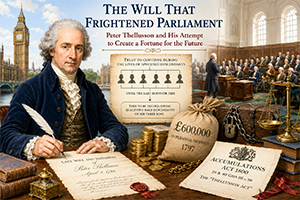
 Most unusual wills create family disputes. Peter Thellusson’s will did something much more remarkable: it helped cause the English Parliament to change the law.
Thellusson was an extraordinarily wealthy eighteenth-century merchant and banker. When he died in 1797, instead of simply leaving his fortune to his children and grandchildren, he directed that much of it be invested and accumulated for decades. The income would be reinvested, generating still more income for the benefit of future generations.
The plan was legal. It was also so controversial that Parliament decided future testators should not be permitted to do the same thing.
Who Was Peter Thellusson?
Peter Thellusson was born in Geneva in 1737 and eventually became a successful merchant and banker in England.
His will, dated April 2, 1796, made various provisions for his wife and family but placed the bulk of his remaining property into an extraordinary trust.
Contemporary accounts describe Thellusson as leaving more than £600,000 in personal property, in addition to substantial real estate. In terms of purchasing power, £600,000 in 1797 would be roughly equivalent to $80 million in today’s U.S. dollars.
The Fortune That No One Could Spend
The trustees were directed to collect the income from much of Thellusson’s property and use it to acquire still more property. The process would continue during the lives of specified descendants.
Only after the last survivor of those designated people died would the accumulated estate finally be divided, principally among qualifying male descendants of his three sons.
Thellusson was essentially trying to use compound growth to create an even larger fortune for future generations while preventing the intervening generations from spending it.
How Large Could the Fortune Become?
The possibilities fascinated—and alarmed—Thellusson’s contemporaries. Some calculations predicted that the estate could eventually grow to tens of millions of pounds, the equivalent of a multibillion-dollar fortune today.
Whether those projections were realistic was less important than the concept. Thellusson was attempting to use time and compound growth to transform an already enormous fortune into something vastly larger.
His family challenged the will.
The Family Goes to Court
The resulting litigation became known as Thellusson v. Woodford.
The principal Chancery decision is reported as Thellusson v. Woodford (1799) 4 Ves. Jr. 227, 31 Eng. Rep. 117, and the matter later reached the House of Lords. A report of the case can be read here:
https://vlex.co.uk/vid/thellusson-v-woodford-woodford-805682377
The family attacked the accumulation scheme, but there was an important problem: however unreasonable the arrangement might appear, that did not necessarily make it illegal.
The courts concluded that the will remained within the boundaries imposed by the rule against perpetuities, and the House of Lords ultimately upheld the essential validity of the arrangement.
What Is the Rule Against Perpetuities?
The rule against perpetuities is one of the most famously complicated rules in property law, but its basic purpose is relatively simple:
A person cannot control the ownership of property forever.
Under the traditional common-law rule, a future interest generally had to become certain to vest, if at all, no later than 21 years after the death of a relevant person who was alive when the interest was created. Lawyers commonly summarize this as:
“A life in being plus 21 years.”
The rule was intended to prevent people from tying up property indefinitely and controlling its ownership many generations after their deaths.
Thellusson’s will pushed that rule close to its limits.
How Thellusson Stayed Within the Rule
Thellusson did not simply direct that his fortune remain in trust for 100 or 200 years.
Instead, he tied the trust to the lives of specified people who were alive when he died. The accumulation would continue until the last survivor of that group died. In legal terminology, the people whose lives determine the permissible duration of such an arrangement are often referred to as “measuring lives.”
Because those measuring lives were people already alive at Thellusson’s death, the courts concluded that the arrangement did not violate the rule against perpetuities.
But there was a loophole of sorts. The rule against perpetuities restricted how long future ownership could remain unsettled. It did not adequately restrict how long the income from property could be accumulated instead of distributed.
Thellusson had therefore found a way to comply with the rule against perpetuities while still requiring his fortune to grow untouched for decades.
That prompted Parliament to act.
Parliament Responds: The “Thellusson Act”
In 1800, Parliament enacted the Accumulations Act 1800, 39 & 40 Geo. III c. 98, commonly known as the Thellusson Act.
The new law restricted how long someone could direct trustees to accumulate income rather than distribute it to beneficiaries.
Importantly, Parliament did not invalidate Thellusson’s own will. The legislation instead prevented future testators from using the same type of arrangement.
Peter Thellusson therefore accomplished something very few people manage through estate planning:
He wrote a will so controversial that the legislature changed the law.
Did His Plan Work?
Not as spectacularly as Thellusson may have envisioned.
The trust continued for decades, but so did litigation over the estate. Legal disputes and administration expenses consumed substantial amounts of money that otherwise could have continued accumulating.
There is an obvious irony: Thellusson designed his estate plan to take advantage of compound growth, but his complicated will also produced decades of compound litigation.
The Rule Against Perpetuities Today
The traditional rule against perpetuities became notorious for its complexity. Determining whether an interest might vest too remotely could require lawyers and judges to analyze hypothetical events that were extremely unlikely ever to occur. A drafting mistake could invalidate a provision even though the problem might not become apparent for many years.
As a result, many American states have modified or replaced the traditional common-law rule by statute.
Modern statutes often substitute a fixed period of years, or provide an alternative fixed period, rather than relying exclusively on the old formula of “a life in being plus 21 years.” The permitted period varies considerably from state to state, and some jurisdictions have gone much further by permitting trusts to continue for hundreds of years or, in certain circumstances, indefinitely.
Massachusetts has also modified the traditional rule by statute. The modern law therefore differs substantially from the common-law rule that governed Peter Thellusson’s will.
The basic policy question, however, remains the same: How long should someone who has died be permitted to control property that will ultimately belong to future generations?
What Peter Thellusson’s Will Can Teach Us Today
Thellusson’s extraordinary will provides several lessons that remain relevant to estate planning today.
Just because an estate plan is legal does not mean it is wise. Thellusson succeeded in creating an arrangement that complied with existing law, but it produced decades of family conflict and litigation.
Control from the grave has limits. Trusts can control how and when beneficiaries receive property, but the law may limit how far into the future that control can extend.
Complexity can be expensive. An elaborate estate plan intended to preserve wealth can instead generate disputes and legal expenses that diminish it.
Perhaps the most important lesson is that a good estate plan should not be judged solely by whether it is legally permissible. It should also be practical, understandable, and designed to transfer wealth without creating unnecessary conflict.
Peter Thellusson succeeded in creating one of history’s most famous wills—but that does not necessarily mean he created a successful estate plan.