
Every Thanksgiving, Americans remember the Pilgrims who arrived aboard the Mayflower in 1620 and celebrated a harvest feast the following year.
We picture the Mayflower, Plymouth Rock, and a gathering of English settlers and Native Americans sharing a meal. What we sometimes forget is that many of the passengers who endured the Atlantic crossing never lived long enough to see that first Thanksgiving.
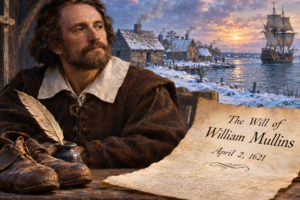
One of them was William Mullins, an English shoemaker who arrived in Plymouth with his wife, two children, and a servant.
Mullins died on February 21, 1621, during the colony’s first winter. He left behind a will that has survived for more than 400 years.
His is the only known surviving will of a person who died during Plymouth Colony’s first winter.
His will and the administration of his estate provide a record of family relationships, business assets, inheritance decisions, and the difficulties of settling an estate when the deceased’s property and beneficiaries were separated by an ocean.
A Shoemaker Sails to the New World
William Mullins was born around 1572 and came from Dorking, Surrey, England.
In 1620, he boarded the Mayflower with his wife Alice, their children Joseph and Priscilla, and a servant named Robert Carter. Two older children, William and Sarah, remained in England.
Mullins was not simply an impoverished passenger seeking a better life. His surviving will reveals that he possessed business inventory, debts owed to him, and interests in the colonial enterprise.
He was also among the men who signed the Mayflower Compact in November 1620, establishing a framework for governing the settlement.
The Mayflower passengers arrived in New England late in the year. They faced severe winter weather, inadequate shelter, disease, and shortages of food. By the time spring arrived, approximately half of the Mayflower’s passengers had died.
Mullins was among them.
A Deathbed Will in the Wilderness
As Mullins approached death, he apparently dictated his wishes concerning his property and family. His will is generally considered a nuncupative will, meaning a will made orally rather than originally prepared and signed as a conventional written instrument.
The surviving document is dated April 2, 1621, several weeks after his death. It appears to record instructions he gave shortly before dying.
The document identifies three witnesses: John Carver, Giles Heale, and Christopher Jones. Carver was the colony’s first governor, Heale was the Mayflower’s surgeon, and Jones was its captain.
The will begins with a customary declaration committing his soul to God and his body to the earth.
Mullins then proceeded to distribute his property.
The handwritten document has survived.
A copy of William Mullins’s handwritten will, together with a complete transcription and a translation of the Latin probate entry, can be viewed at:
https://mayflowerhistory.com/will-of-william-mullins
Twenty-One Dozen Pairs of Shoes
Mullins, a shoemaker and businessman, gave detailed instructions concerning his business inventory. It may have been among the most valuable assets he brought to the colony.
He owned 21 dozen pairs of shoes and 13 pairs of boots.
That amounts to 252 pairs of shoes and 13 pairs of boots.
These were merchandise, presumably brought to New England as part of his business activities.
Mullins proposed that the colonial company take the footwear at a valuation of £40, with payment contemplated at the end of seven years. If the company considered the price excessive, his overseers were authorized to make an appropriate arrangement.
He also addressed nine shares in the colonial enterprise, allocating two shares each to his wife Alice and his children William, Joseph, and Priscilla, with one share going to the company.
An estate may consist of more than a home, bank accounts, and personal belongings. Business inventory, contractual rights, debts owed to the deceased, and investments can all become part of an estate.
Mullins provided instructions for the disposition of those assets.
One Daughter Received Ten Shillings
Mullins had four children identified in his will: William, Sarah, Joseph, and Priscilla. His will treated them differently.
He directed that £40 held by a person identified as Goodman Woodes be divided into four £10 portions for his wife Alice, his son Joseph, his daughter Priscilla, and his eldest son William.
William also received additional debts, bonds, bills, and other property interests.
Sarah, his eldest daughter, received just ten shillings, to be paid from her brother’s property.
The will does not explain why Sarah received less than the other children.
Wills tell us what a person wanted to happen to their property, but they do not always tell us why.
Even today, a parent who leaves substantially different inheritances to children without explaining the decision may unintentionally create resentment, suspicion, or litigation.
A will can be a person’s final opportunity to explain an important decision. Mullins left us the distribution, but not the explanation.
An Inheritance Conditioned on Crossing the Atlantic
Another provision concerned Mullins’s land in the colony.
He directed that his son William could receive his share of land if William came to Virginia.
At the time, the English sometimes used the name Virginia broadly in connection with colonial territory, even though the Mayflower passengers had landed in New England.
Mullins was tying the inheritance to a decision that would require William to leave England and cross the Atlantic.
This is an early example of a conditional inheritance.
Modern wills and trusts sometimes contain conditions affecting when or whether a beneficiary receives property. Such provisions can raise questions about enforceability, public policy, and the testator’s intentions.
Mullins’s condition also reflected the circumstances of the settlement. Its survival and growth depended on people willing to make the voyage.
His Request for the Care of His Family
Near the end of the will, Mullins named John Carver and a man identified as Mr. Williamson as overseers of his will.
He left each of them twenty shillings.
He also asked them to look after his wife and children and to act as fathers and friends to them.
Mullins’s wife and younger children were in a colony thousands of miles from their former home. His older children remained in England.
He could distribute money, merchandise, and land, but he could not guarantee that his family would be provided for after his death.
He therefore asked people he trusted to care for them.
Estate planning is not exclusively about money. Parents and spouses also consider who will protect their loved ones, who will make responsible decisions, and who will provide guidance when they are gone.
The Mayflower Carried His Will Back to England
The Mayflower departed Plymouth for England in April 1621, carrying a written copy of Mullins’s will across the Atlantic.
In 1621, Plymouth was an English colonial settlement and had not yet established its own probate court or system for administering estates. Probate jurisdiction was exercised through the English ecclesiastical courts, including the Prerogative Court of Canterbury, which dealt with estates of persons who died overseas.
Accordingly, Mullins’s will was taken to England for probate proceedings. On July 23, 1621, the Prerogative Court of Canterbury granted administration of his estate.
Mullins named John Carver and Mr. Williamson as overseers of his will but did not appoint an executor.
The English probate record specifically states that no executor had been named. Consequently, authority to administer the estate was granted to his daughter Sarah Blunden, who remained in England.
Sarah received only ten shillings under the will, yet she became the person legally authorized to administer her father’s estate.
The person responsible for administering an estate is not necessarily the person who receives the largest inheritance.
The Daughter Who Survived
Five members of the Mullins household traveled aboard the Mayflower: William Mullins, his wife Alice, their children Joseph and Priscilla, and their servant Robert Carter.
William died in February 1621. Alice, Joseph, and Robert Carter also died during the colony’s first winter and spring.
Of those five passengers, only Priscilla survived.
She later married another Mayflower passenger, John Alden.
Their marriage became one of the best-known stories associated with Plymouth Colony, particularly after Henry Wadsworth Longfellow popularized a romanticized account in his poem The Courtship of Miles Standish.
Priscilla and John Alden established a family whose descendants would number in the thousands.
Mullins never lived to see his daughter’s marriage, the growth of Plymouth Colony, or the first Thanksgiving.
Through Priscilla, his family became part of the history of early New England.
What William Mullins’s Will Teaches Us Today
More than four centuries have passed since William Mullins dictated his final wishes.
The circumstances of his death were different from those of most people today, but many of the concerns reflected in his will remain familiar.
He wanted to provide for his wife and children. He needed to distribute business property and investments. He made unequal gifts to his children. He placed a condition on an inheritance. He selected people he trusted to carry out his wishes.
He also left unanswered questions.
Why did Sarah receive so little? Would his business assets be sold at the price he anticipated? Would his son William cross the Atlantic to claim the land? Who would care for his family after his death?
Some of those questions can be answered through historical records. Others may never be resolved.
There is another lesson in the fact that Mullins apparently expressed his wishes orally and that the surviving document was prepared after his death.
In the early colonial period, the circumstances of everyday life could make the preparation of a formal written will difficult. Trained lawyers were scarce, literacy was not universal, and established courts and legal institutions were often distant or nonexistent.
Oral wills offered a way for dying individuals to express their final wishes when conventional written documents were impractical. Their recognition, however, depended on the law applicable at the time and place.
Modern Massachusetts law generally requires a will to be in writing and executed with the formalities prescribed by statute. A person should not assume that oral instructions, however clearly expressed, will constitute a valid will today.
Properly prepared estate planning documents can help prevent uncertainty about a person’s wishes and reduce the possibility of disputes and litigation among surviving family members.
A will also provides an opportunity to explain decisions that might otherwise leave surviving family members with unanswered questions.
William Mullins died before the first Thanksgiving. He never saw Plymouth Colony flourish, and he could not have known that people would still be examining his will more than four centuries later.
His will records his property, his inheritance decisions, and his instructions for the care of his family.
William Mullins never lived to celebrate the first Thanksgiving, but more than four centuries later, his will still speaks for him.