
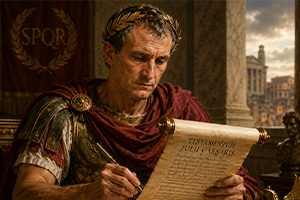
 “In his last will, however, he named three heirs, his sisters’ grandsons, Gaius Octavius, to three-fourths of his estate, and Lucius Pinarius and Quintus Pedius to share the remainder. At the end of the will, too, he adopted Gaius Octavius into his family and gave him his name. He named several of his assassins among the guardians of his son, in case one should be born to him, and Decimus Brutus even among his heirs in the second degree. To the people he left his gardens near the Tiber for their common use and three hundred sesterces to each man.” The Life of Julius Caesar, 83.2, Suetonius translated by J. C. Rolfe
The last will and testament of Julius Caesar may be the most consequential will ever written. Although the original document has not survived, ancient historians recorded its contents, and the effects of the will changed the course of world history.
More than two thousand years after Caesar’s death, lawyers, historians, and students of government still study the remarkable document that helped transform the Roman Republic into the Roman Empire.
Who Was Julius Caesar?
Julius Caesar was one of the most influential figures in Roman history. A military commander, politician, and statesman, he expanded Rome’s territory and accumulated enormous power. By 44 B.C., Caesar had been appointed “dictator perpetuo” (dictator for life), a position that alarmed many Roman senators who feared he intended to become a king. On March 15, 44 B.C.—the famous “Ides of March”—Caesar was assassinated.
The Reading of the Will
After Caesar’s death, his will was publicly read to the citizens of Rome. The contents suprised many Romans. The will revealed that Caesar had left substantial gifts not only to family members but also to the people of Rome themselves. Ancient sources report that Caesar left a cash gift to every Roman citizen and bequeathed his private gardens for public use.
These generous provisions helped turn public opinion against the assassins. Rather than celebrating Caesar’s death, many Romans became outraged by the murder of a leader who had remembered ordinary citizens in his estate plan. The reading of the will helped fuel political unrest that eventually led to civil war.
The Most Important Provision
The most significant clause in the will was Caesar’s designation of his principal heir. Caesar named his eighteen-year-old grandnephew, Gaius Octavius, as his adopted son and primary beneficiary. This young man would later become known to history as Augustus Caesar.
At the time of Caesar’s death, Octavius was not one of Rome’s most powerful figures. The inheritance changed everything. The will gave Octavius wealth, status, legitimacy, and perhaps most importantly, the right to use Caesar’s name. He became Gaius Julius Caesar Octavianus—commonly known as Octavian. When Caesar’s will was opened, an eighteen-year-old unexpectedly became the adopted son and principal heir of the most famous man in Rome. Within thirteen years, that young heir would defeat Brutus, Cassius, Sextus Pompey, Lepidus, Mark Antony, and Cleopatra, ultimately becoming Augustus, the first Roman Emperor. Few inheritance decisions have had greater consequences.
The Roman Republic ended. The Roman Empire began. One provision in one will helped alter the future of Western civilization.
Estate Planning Lessons from Caesar’s Will
Although most clients are not planning the future of an empire, Caesar’s will contains several lessons that remain relevant today.
1. A Will Can Shape a Legacy
Many people think a will simply distributes property. A well-crafted estate plan can do much more. It can support charitable causes, provide for loved ones, preserve family values, and create a lasting legacy. More than two millennia later, Caesar’s final wishes are still being discussed.
2. Choosing the Right Beneficiary Matters
The selection of an heir can have consequences far beyond the transfer of assets. Caesar’s choice of Octavian proved to be one of the most important inheritance decisions in history. While few estate plans will influence world events, choosing trustworthy and capable beneficiaries remains an important part of modern estate planning.
3. Public Gifts Can Build Goodwill
Caesar’s gifts to the Roman people generated enormous public support. Modern estate plans frequently include charitable bequests to educational institutions, religious organizations, hospitals, and other worthy causes. Such gifts can continue a person’s values long after death.
4. Estate Planning Is Important Regardless of Wealth
Caesar understood the importance of documenting his intentions. Without a written will, disputes and uncertainty can arise. Whether an estate is large or modest, proper planning can reduce confusion and help ensure that assets pass according to the person’s wishes.
Did the Original Will Survive?
Unfortunately, the original will has been lost to history. However, ancient historians including Suetonius, Plutarch, and Appian recorded its contents, allowing modern scholars to reconstruct many of its provisions. As a result, Caesar’s will remains one of the best-known lost legal documents in history.
Final Thoughts
Julius Caesar’s will helped determine the future ruler of Rome, influenced public opinion after his assassination, contributed to a civil war, and played a role in the creation of one of history’s greatest empires. For that reason, it may be the most important will ever written.