
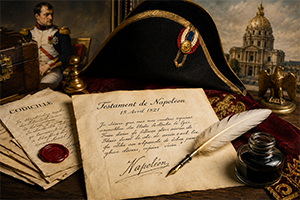
Few wills in history are as fascinating as that of Napoleon Bonaparte. The former Emperor of the French did not merely distribute his property. He used his Last Will and Testament as one final political statement, a personal defense of his legacy, and, perhaps, one last strategic maneuver against his enemies.
Drafted while he was imprisoned on the remote island of Saint Helena after his defeat at Waterloo, Napoleon’s will reflects the mind of a man who never stopped planning, negotiating, and thinking several moves ahead. More than two centuries later, his estate remains one of history’s most intriguing examples of how a will can serve purposes far beyond simply transferring property.
Exile on Saint Helena
Following his defeat at the Battle of Waterloo in 1815, Napoleon surrendered to the British. Rather than imprisoning him in Europe where supporters might attempt a rescue, the British exiled him thousands of miles away to the isolated island of Saint Helena in the South Atlantic Ocean.
There, under constant British supervision, Napoleon spent the last six years of his life. Although stripped of his empire, he remained deeply concerned with his reputation, his family, and the disposition of his property.
On April 15, 1821—less than a month before his death—Napoleon executed what became his final Last Will and Testament followed by a number of codicils to the will.
A Surprisingly Detailed Will
Napoleon’s will is far more detailed than many modern wills.
Rather than simply naming beneficiaries, he carefully identified family members, loyal military officers, longtime servants, physicians, and political supporters who were to receive gifts from his estate. Many of these bequests were designed not only to reward loyalty but also to preserve the memory of his reign.
He left generous gifts to members of his household who had remained faithful during his exile, demonstrating that Napoleon never forgot those who had stood beside him after his empire had collapsed.
The will also directed charitable gifts and provided instructions concerning personal property, books, medals, and keepsakes.
The Famous Burial Request
Perhaps the most famous provision of Napoleon’s will was not financial at all.
He wrote:
“I desire that my ashes may rest on the banks of the Seine, in the midst of the French people whom I have loved so much.”
Napoleon did not wish to remain buried on the isolated island where the British had imprisoned him.
His request was ignored at first.
When Napoleon died on May 5, 1821, the British buried him on Saint Helena despite his clearly expressed desire to be buried in France.
Nearly twenty years later, political attitudes had changed dramatically. In 1840, King Louis-Philippe obtained permission from Great Britain to return Napoleon’s remains to France in what became known as the Retour des Cendres (“Return of the Ashes”).
After an elaborate state funeral in Paris, Napoleon was eventually entombed beneath the magnificent dome of Les Invalides, where millions of visitors continue to pay their respects today. Although delayed by almost two decades, one of the most important wishes in his will was ultimately fulfilled.
Napoleon’s Use of Codicils
One of the more fascinating aspects of Napoleon’s estate planning was his extensive use of codicils.
A codicil is a legal document that modifies or supplements an existing will without replacing it entirely. Estate planning attorneys continue to use codicils today when clients wish to make limited changes rather than execute an entirely new will.
Napoleon executed multiple codicils during his final weeks on Saint Helena.
Some clarified gifts. Others altered beneficiaries or added additional instructions.
But historians have long believed that the codicils served another purpose as well.
A Deliberate Deception?
Many historians believe Napoleon intentionally used his codicils to misdirect the British authorities who closely monitored nearly every aspect of his life.
The British carefully watched his correspondence, visitors, finances, and papers. Napoleon understood that anything written in his will might eventually be examined by his captors.
Some scholars have argued that portions of the codicils were drafted to obscure his true financial situation or create uncertainty regarding the location and ownership of certain assets.
Whether every change was genuine or partly intended as strategic misdirection remains a subject of historical debate, but the possibility reflects Napoleon’s lifelong talent for using information—and misinformation—as a weapon.
The Hidden Money
Another mystery surrounding Napoleon’s estate involved money that he reportedly concealed from the British during his exile.
The British imposed financial restrictions on Napoleon and closely monitored his expenditures. Yet evidence suggests that he retained access to substantial sums that had escaped British control.
Some historians believe references within his will and codicils were intentionally crafted to protect or indirectly identify these hidden funds without revealing their precise location to British officials. If true, the will became more than an estate-planning document—it became a coded financial roadmap intended for trusted followers while concealing valuable assets from his captors.
The precise extent of Napoleon’s hidden wealth remains uncertain, adding another layer of intrigue to an already remarkable testament.
Litigation After Napoleon’s Death
Like many famous estates, Napoleon’s did not pass quietly to his beneficiaries.
His death generated years of legal disputes involving heirs, creditors, former officials, and questions concerning the administration of his estate.
Political complications made matters even more difficult. Napoleon had ruled an empire that no longer existed, many assets had been confiscated or scattered across Europe, and governments differed over ownership of various properties and obligations.
Some beneficiaries experienced significant delays before receiving their inheritances, while other claims required lengthy legal and diplomatic resolution.
The administration of Napoleon’s estate illustrates a lesson still familiar to probate attorneys today: even a carefully drafted will cannot eliminate every dispute, particularly when substantial wealth, political upheaval, and international assets are involved.
Why Napoleon’s Will Still Matters Today
Napoleon’s Last Will and Testament continues to interest lawyers, historians, and estate planners because it demonstrates several timeless principles.
First, a will can accomplish much more than distributing money. It can preserve family history, reward loyalty, express deeply held personal values, and influence how future generations remember the deceased.
Second, Napoleon’s careful use of codicils illustrates how estate plans may evolve over time as circumstances change. Modern estate planning often requires periodic updates rather than wholesale replacement of an existing will.
Third, the disputes that followed Napoleon’s death remind us that even sophisticated estate planning cannot always prevent litigation. International assets, political uncertainty, creditor claims, and ambiguous property rights can complicate probate long after a will has been signed.
Finally, Napoleon’s successful request to be reburied in France demonstrates that testamentary wishes sometimes outlive political opposition. Although it took nearly twenty years, one of the most important instructions in his will was ultimately honored.
Where to Read Napoleon’s Will
An English translation of Napoleon’s Last Will and Testament is available through the Napoleon Series, one of the leading scholarly resources devoted to Napoleonic history:
https://www.napoleon-series.org/research/napoleon/c_will.html
The French original is also preserved in historical archives and has been reproduced in numerous scholarly publications.
Final Thoughts
Napoleon Bonaparte spent his life commanding armies, governing an empire, and reshaping Europe. Even in exile, he remained a strategist.
His Last Will and Testament was not merely a legal document. It was part financial plan, part political manifesto, part historical record, and perhaps even part deception. Through its careful drafting, strategic codicils, and enduring influence, Napoleon’s will reminds us that estate planning is often about far more than property—it is about legacy.