
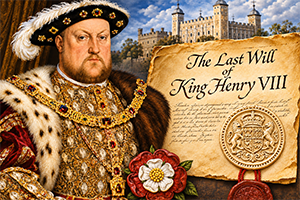
King Henry VIII of England is probably best remembered for having six wives, two of whom he had executed. He is also remembered for breaking with the Roman Catholic Church and establishing himself as head of the Church of England. Less well known is his attempt to control who would inherit the English throne after his death through the terms of his last will.
Henry became king in 1509 at the age of 17. During his nearly 38-year reign, he exercised enormous influence over Parliament and used legislation to accomplish his personal and political objectives. When the Pope refused to annul his marriage to Catherine of Aragon, Henry secured legislation rejecting papal authority in England and recognizing him as the supreme head of the Church of England.
One of Henry’s principal concerns was producing a legitimate male heir. Catherine gave birth to a daughter, Mary, but no surviving son. Henry feared that the absence of a male successor would threaten the stability of the Tudor dynasty.
Henry eventually obtained an annulment of his marriage to Catherine and married Anne Boleyn. Anne gave birth to another daughter, Elizabeth, but failed to produce a surviving son. She was subsequently executed, and Henry married Jane Seymour.
In 1537, Jane finally gave Henry the son he wanted, Edward. Unfortunately, Jane died shortly after childbirth. Henry would marry three more times, but Edward remained his only legitimate son.
By the end of his life, Henry had three surviving children, but his determination to control the succession had not diminished.
Changing the Law to Control the Succession
Ordinary people prepare wills to determine how their property will be distributed after death. Henry VIII wanted to do considerably more. He wanted to determine who would become the next sovereign of England and who would inherit the throne if his immediate successors died without children.
To accomplish this, Henry used Parliament to change the law.
In 1534, Parliament passed the First Act of Succession, which excluded Mary from the succession and recognized the children of Henry’s marriage to Anne Boleyn as his lawful heirs.
After Anne’s execution in 1536, Parliament passed another Act of Succession. This legislation excluded both Mary and Elizabeth, declared them illegitimate, and favored children Henry might have with Jane Seymour or a subsequent wife.
The 1536 legislation also authorized Henry, under specified circumstances, to determine the succession by letters patent or by his last will.
In 1544, Parliament passed the Third Act of Succession, which restored Mary and Elizabeth to the line of succession after Edward and any other eligible children Henry might have. The legislation also preserved Henry’s extraordinary authority to determine further succession arrangements through his will.
Henry did not need Parliament to establish that a woman could inherit the throne. That possibility already existed under English succession principles.
What Henry changed was the identity and order of the people entitled to inherit, and his own authority to determine the succession by will.
His legislation first excluded Mary, then Elizabeth, and eventually restored both daughters to the succession without formally legitimizing them.
Thus, Henry had accomplished something that ordinary testators could never do. He had obtained statutory authority to use his will to determine who would inherit the English throne.
Preparing Henry’s Last Will
By December 1546, Henry was 55 years old and seriously ill. His final will was dated December 30, 1546, less than a month before his death on January 28, 1547.
Henry did not personally write his signature on the document. Instead, his signature was applied using a device known as a dry stamp, which reproduced his signature. This was an established method of authenticating royal documents during the later years of Henry’s reign.
Although the legislation authorizing Henry to determine the succession by will required a document signed with his own hand, the authorities at the time accepted the will and acted upon its provisions.
What Did Henry’s Will Provide?
The most important provisions concerned succession to the throne.
Henry directed that the crown would pass first to his son Edward and Edward’s descendants.
If Edward died without descendants, the crown would pass to any eligible children Henry might have with his sixth wife, Catherine Parr, or a future wife, and their descendants.
If there were no such descendants, the crown would pass to his daughter Mary and her descendants, followed by Elizabeth and her descendants.
Henry also attempted to control his daughters’ marriages. Under the will, Mary and Elizabeth could lose their rights to the throne if they married without the written consent of the required majority of designated Privy Councillors.
Henry then addressed what would happen if none of his children left descendants.
He directed that the crown would pass through the descendants of Lady Frances Brandon, the eldest daughter of his younger sister Mary Tudor, and then through the descendants of Frances’s sister Eleanor.
Significantly, Henry bypassed the descendants of his older sister Margaret Tudor, whose family included the Scottish royal line. The will did, however, contain an ultimate fallback provision referring to Henry’s right heirs.
Henry was attempting to determine the succession not merely for the next generation, but potentially for generations to come.
The Other Provisions of the Will
Although the succession provisions attract the most attention, Henry’s will also contained more conventional provisions concerning property, money, and burial arrangements.
His surviving wife, Catherine Parr, was to receive £3,000 in plate, jewels, and other possessions, together with £1,000 in money and the property provided through her marriage settlement.
Mary and Elizabeth were each provided with substantial financial arrangements. These included £10,000 marriage provisions and £3,000 for maintenance, subject to the conditions and arrangements specified in the will.
Henry also made numerous gifts to servants, advisers, and members of his household.
He directed that his debts be paid and made elaborate arrangements for his burial at Windsor, alongside Jane Seymour, the wife who had given birth to Edward.
The will also contained extensive religious provisions. Henry requested prayers for his soul, masses, and other religious observances. These instructions are particularly interesting because, although Henry had rejected the authority of the Pope, he retained many traditional Catholic religious beliefs and practices.
Sixteen Executors to Manage the Kingdom
Henry appointed 16 executors to carry out the will. They were also intended to exercise collective authority in governing the country during Edward’s minority.
Ordinarily, executors are responsible for gathering a deceased person’s assets, paying debts and expenses, and distributing property according to the will.
Henry’s executors had considerably greater responsibilities. They were expected to help govern an entire kingdom.
Henry also directed that Edward follow the guidance of these advisers concerning his marriage and other important affairs until he reached the age of 18.
Edward was only nine years old when Henry died.
The arrangement did not operate as Henry had planned. Shortly after his death, Edward Seymour, the young king’s uncle, became Lord Protector and assumed authority that Henry had intended to be exercised collectively.
Appointing 16 executors, it turned out, did not guarantee that all 16 would remain in charge.
Did Henry’s Estate Plan Work?
Only partially.
Edward VI inherited the throne in 1547, as Henry had directed. However, Edward died in 1553 at the age of 15, without children.
Before his death, Edward attempted to change the succession by excluding Mary and Elizabeth and favoring Lady Jane Grey, a descendant of Henry’s younger sister.
Jane was proclaimed queen, but her reign lasted only nine days before Mary successfully claimed the throne.
Mary ruled until 1558, when she died without children. Elizabeth then became queen and ruled for more than 44 years.
Elizabeth never married and had no children.
When she died in 1603, the English throne passed to James VI of Scotland, who became James I of England.
James was a descendant of Margaret Tudor, Henry’s older sister—the branch of the family Henry had attempted to bypass in favor of his younger sister’s descendants.
Thus, Henry’s succession arrangements initially operated much as he intended. Edward, Mary, and Elizabeth each inherited the throne in the order Henry had established.
However, after all three died without descendants, the crown eventually passed outside the family lines Henry had favored.
What Can We Learn From Henry VIII’s Will?
Although Henry’s son Edward was alive when Henry prepared his will, Henry anticipated the possibility that Edward might die before him or die without descendants. He therefore included detailed alternative provisions identifying who would inherit the throne if Edward or his descendants did not survive.
American lawyers do not ordinarily prepare wills determining who will become the monarch of a country. However, providing for alternative beneficiaries is a common and important part of drafting a will.
Lawyers anticipate the possibility that a beneficiary may die before the person making the will, or after that person’s death but before receiving the intended inheritance. A properly drafted will should address these possibilities and specify who will receive the property if the intended beneficiary cannot inherit.
Henry VIII’s will provides a useful lesson in estate planning. Even when the intended heir is alive and well when a will is prepared, circumstances can change. A carefully drafted will should anticipate the premature death of beneficiaries and provide alternative instructions rather than leave the distribution of an estate to chance.
Read Henry VIII’s Will
Text of Henry VIII’s will: The published historical abstract appears in Letters and Papers, Foreign and Domestic, Henry VIII, Volume 21, Part 2, Item 634, dated December 30, 1546.
https://www.british-history.ac.uk/letters-papers-hen8/vol21/no2/pp313-348
View the original will: The original manuscript is preserved in the United Kingdom’s National Archives under reference E 23/4. The National Archives provides a photograph of the document.